Unibet in Sri Lanka: Blocked Domain and Payment Risk Review
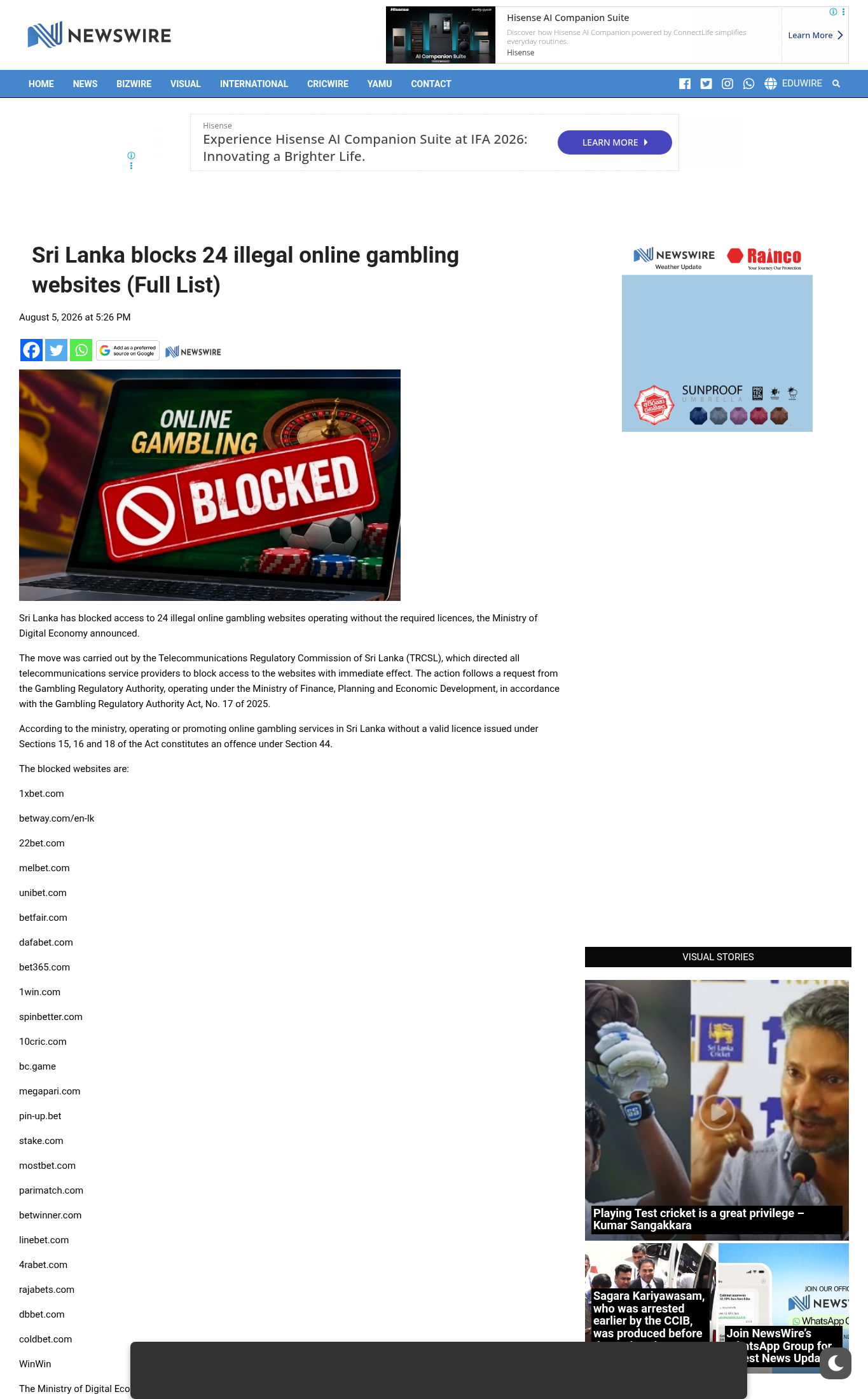
Bottom line: the current signal for using the exact host unibet.com from Sri Lanka is red. A dated local report attributes a Ministry/TRCSL order to block 24 illegal online gambling websites and names the exact domain in its list. The current Sri Lankan record does not verify an operator or licence for that host. This is an adverse access and compliance finding, not proof that every service using the same brand is identical or that a particular user has been defrauded.

Start with the money trail
A safe payment decision begins with the entity that would receive money and the entity responsible for returning it. Do not rely on a familiar name, a search result, a bonus message or a logo. Match the displayed host, legal operator, licence number, payment beneficiary and customer-support identity before depositing. For this review, that chain is incomplete: the operator is not verified in the current Sri Lankan record, no current Sri Lankan licence has been verified, and the exact domain is reported blocked.
There was no live account creation, card payment, bank transfer, wallet deposit or withdrawal test. Consequently, the following practical questions cannot be answered from tested experience: whether a Sri Lankan payment rail accepts funds, whether the beneficiary name matches the operator, how long a withdrawal would take, what fees might apply, or whether a withdrawal would complete. Any page claiming a tested cash-out would go beyond the supplied evidence.
| Money question | Current finding | Practical implication |
|---|---|---|
| Who receives the deposit? | Not verified for the Sri Lankan record | Do not infer the beneficiary from the brand name |
| Who owes the withdrawal? | Responsible legal entity not verified | A payment dispute may be difficult to route |
| Was a withdrawal tested? | No | Processing time and success are unknown |
| Is the exact host available? | Reported in a local block order | Do not bypass a block to send funds |
Exact host, operator and licence match
The relevant host is unibet.com. A host is the address used in the browser; it is not automatically the name of a licensed company. A proper match would connect that address to a named legal entity, a regulator, a licence number, the permitted activity and a current status. The supplied packet does not provide those linked details for Sri Lanka. It instead records the operator as “Not verified in the current Sri Lankan record” and the licence position as “No current Sri Lankan licence verified; exact domain reported blocked.”
The supplied logo is only an identification aid. It came from an exact-domain favicon and is classified as an operator-tier brand asset, not as regulatory evidence. A copied logo, similar spelling or redirected page cannot cure a mismatch. Check the address character by character, including the top-level domain, subdomain, spelling and secure connection. HTTPS protects a connection in transit; it does not prove that the business is licensed or that money can be recovered.
| Identity item | What must match | Current status |
|---|---|---|
| Browser host | Exact address shown before login and payment | unibet.com is the reviewed host |
| Operator | Legal name and responsible company | Not verified in the Sri Lankan record |
| Licence | Current Sri Lankan authorisation for the entity and activity | Not verified |
| Brand mark | Useful for recognition only | Not proof of authorisation |
Why the signal is red
The red signal is based on corroborated adverse evidence. The local report dated 5 August 2026 attributes a Ministry/TRCSL block order to Sri Lankan authorities and names the exact 24-domain list. The relevant report can be read in its dated account of the block order and domain list. This finding is stronger than a general warning about offshore gambling because it concerns the precise host under review.
“Blocked” does not by itself establish the outcome of every prior transaction, and it does not prove that an individual complaint is valid. It does mean that attempting to access or fund the reported host carries a material local compliance and recovery risk. A red signal is therefore appropriate for the decision “should a Sri Lankan user deposit on this exact host now?” It is not a finding that every person associated with the wider brand has committed wrongdoing.
What Sri Lankan law evidence does—and does not—show
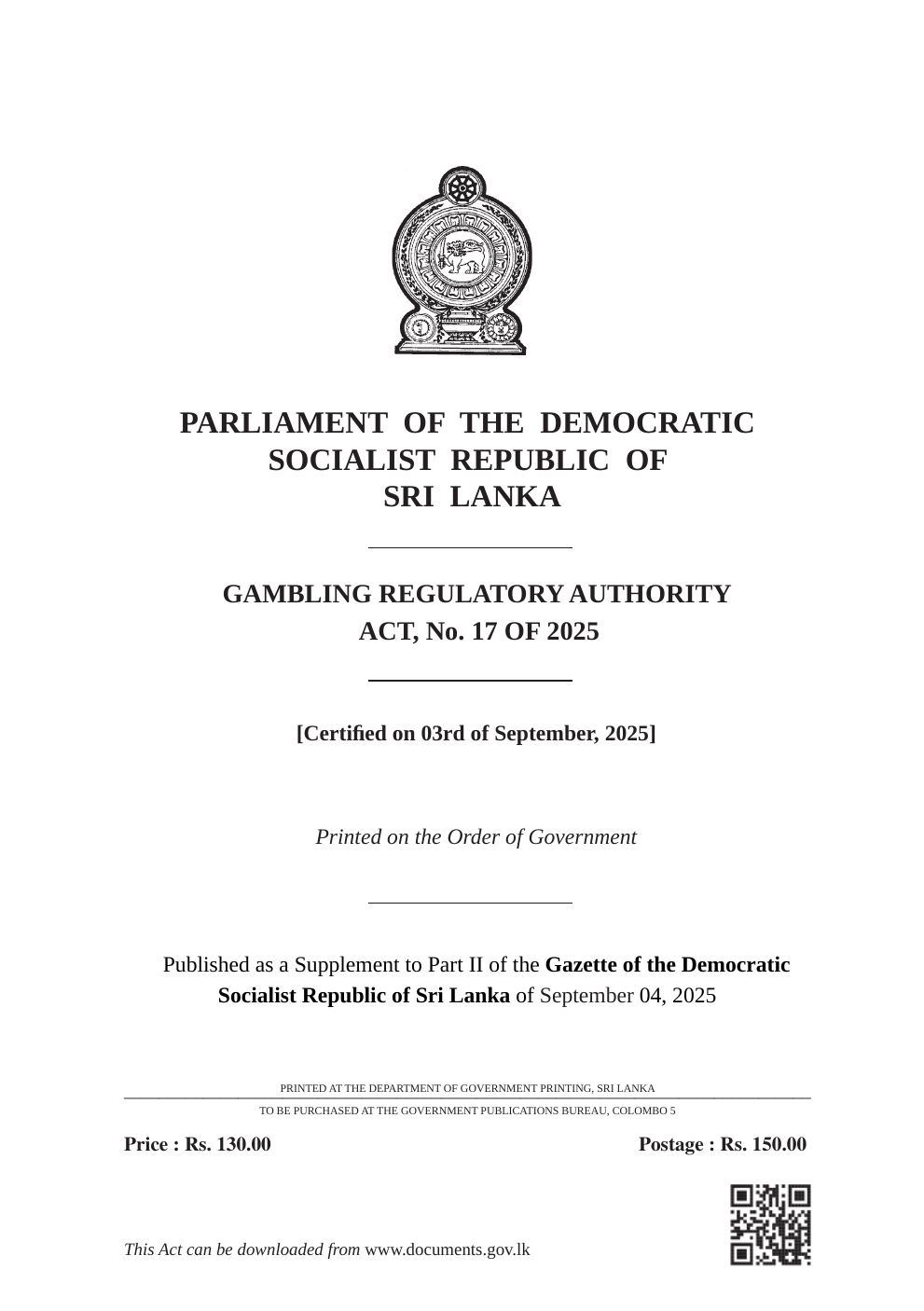
The supplied Act No. 17 of 2025 establishes a Gambling Regulatory Authority and a local licensing framework. That framework is relevant to how a lawful operator should be checked, but the Act does not name this brand and cannot be treated as a licence certificate. The relevant Act No. 17 of 2025 is therefore framework evidence, not brand-specific approval.
Revenue evidence also needs careful treatment. The Inland Revenue Department describes the scope of betting and gaming levy obligations, including internet bookmakers. A levy page can explain the tax environment; it does not prove that a particular website has authorisation to accept a particular customer. The applicable betting and gaming levy information should not be confused with a licence lookup.
| Record | What it supports | What it cannot establish here |
|---|---|---|
| Act No. 17 of 2025 | Regulatory-authority and licensing framework | A licence for the reviewed host |
| Inland Revenue levy information | Levy scope, including internet bookmakers | Payment safety or approval of this operator |
| Ministry/TRCSL block report | Reported adverse action naming the exact domain | Outcome of every individual transaction |
KYC, identity checks and the mismatch risk
Know-your-customer checks are not merely an inconvenience. They determine which entity is collecting identity documents, why the documents are required and where a customer can challenge a decision. A service may request an identity document, address evidence, payment proof or source-of-funds information, but the existence of a request does not prove that the service is locally licensed.
Sri Lanka’s Financial Intelligence Unit describes AML/CFT duties and customer due-diligence thresholds for relevant businesses. Its AML/CFT and customer-due-diligence guidance is useful for understanding why regulated gambling businesses may identify customers and monitor transactions. It does not verify the operator of this host. Do not upload an identity document merely to unlock a withdrawal until the host, legal entity and lawful basis are independently matched.
Warning signs include a payment name different from the stated operator, a request to send funds to a personal account, changing verification demands after a withdrawal request, pressure to deposit more to release winnings, or support that will not state the responsible company. These signs do not prove a crime, but they justify stopping, preserving records and seeking independent help.
Deposits, withdrawals and bank evidence
No payment method was verified and no transaction was performed. A payment icon, a list of currencies or a promotional claim is not bank evidence. A bank statement, wallet record or card entry may show a merchant descriptor, intermediary or processor rather than the public brand. Preserve the original record, date, amount, currency, reference, beneficiary and any related correspondence.
If money has already been sent, avoid making a second deposit to pay a supposed tax, verification charge, unlocking fee or recovery fee. Contact the bank or payment provider through its official customer-service channel promptly and ask whether a transaction can be recalled, disputed or monitored. Do not alter screenshots or forward one-time passwords. The ability to contact a provider does not guarantee recovery, but early, accurate records improve the quality of a complaint.
| Record to preserve | Why it matters | Do not do |
|---|---|---|
| Transaction receipt and reference | Links the amount and date to a payment rail | Do not crop away the reference |
| Merchant or beneficiary description | May identify the receiving party | Do not assume it is the public brand |
| Withdrawal request and reply | Shows the promised and actual sequence | Do not delete contradictory messages |
| Identity-document request | Records what information was sought | Do not send additional documents under pressure |
Complaint route after a payment problem
Begin with a dated written request to the service, asking for the legal operator, transaction explanation, withdrawal status and a specific resolution. Keep the request factual and avoid threats. If the service does not respond, retain the unanswered message as evidence. Then contact the bank, card issuer or wallet provider about the transaction and ask what dispute or fraud-reporting process applies.
For a local regulatory or consumer issue, use the complaint information at our complaints guidance and distinguish a report about blocked access from an allegation of theft. Include the exact host, dates, amounts, payment references, account identifier and copies of correspondence. Do not publish another person’s identity documents or full card details. A complaint remains an allegation unless a competent dated record establishes the facts.
Where immediate financial or personal danger exists, use urgent help information. Gambling-related distress should be treated seriously; do not chase losses with another deposit. Support and self-exclusion information is available through responsible-gambling guidance and self-exclusion guidance.
Clone and redirect checks
Brand impersonation can make a different host appear connected to a familiar service. Check the address from the browser bar rather than an advertisement. Record the first host reached, every redirect, the legal name in the terms, the payment beneficiary and the support address. A shortened link, mirror, mobile subdomain or regional spelling should be treated as a separate host until proven otherwise.
Do not use a virtual private network or another bypass to turn a block into apparent availability. A bypass does not create a Sri Lankan licence, change the responsible entity or guarantee that a bank will process a withdrawal. It can also complicate the factual account given to a bank or regulator. The safest clone check is a documented identity match from a competent current record, not visual similarity.
| Clone check | Pass condition | Failure response |
|---|---|---|
| Address | Exact host is consistent across login and payment | Stop before entering credentials |
| Legal terms | Named entity and jurisdiction are clear | Do not treat a brand name as the entity |
| Payment beneficiary | Matches the verified responsible entity | Do not send funds to an unexplained party |
| Regulatory record | Current record covers the exact entity and activity | Class the licence as unverified |
Check first, then open the decision gateway
What remains unknown
The evidence does not establish the operator’s legal name, a current Sri Lankan licence number, a licence expiry date, available Sri Lankan payment methods, withdrawal performance, customer-service quality, the outcome of any user complaint, or the identity of every host using a similar brand. No account or payment test was performed. These are deliberate boundaries rather than gaps to fill with assumptions.
The absence of a verified fact is not proof of the opposite. For example, an unverified licence is not automatically proof that no licence exists anywhere; it means the current Sri Lankan evidence packet does not verify one. Likewise, the block report supports the reported adverse action against the exact domain, not a universal conclusion about unrelated domains or entities.
Chronology and review method
The chronology starts with the dated 2026 local report identifying the block order and exact-domain list. The regulatory framework is then read separately from tax and AML/CFT material. The framework sources explain the kinds of licensing, due-diligence and levy issues that matter, while the local report supplies the brand-specific adverse finding. The logo is retained only for recognition and is not counted as regulatory support.
The method is intentionally conservative: identify the host, seek an entity match, seek a current local licence match, separate primary records from operator material, record adverse action, and state untested payment questions as unknown. Our evidence methodology explains this separation, while licence-check guidance provides a practical checklist. If a competent authority later publishes a current record that directly matches the host and entity, the conclusion should be reassessed rather than silently edited.
Practical conclusion for Sri Lankan users
On the evidence available, the answer to “is Unibet scam or legit in Sri Lanka?” cannot be reduced to a claim about the brand’s global reputation. The exact host is reported in a Sri Lankan block order, the local operator is not verified, and no current Sri Lankan licence is verified. Those facts make depositing or attempting to bypass the block a high-risk choice. The red signal reflects documented adverse evidence and an unresolved money trail.
If you have not deposited, do not provide funds or identity documents until the exact host, responsible entity and current local authorisation are matched in a competent record. If you have already paid, stop further deposits, preserve the transaction trail, contact the payment provider and make a factual complaint. A review can be corrected when new primary evidence directly addresses the host and entity; it should not be changed because of an unsupported promise, copied certificate or promotional message.
Check first, then open the decision gateway
Frequently asked questions
Is Unibet legal in Sri Lanka?
The current record does not verify a Sri Lankan licence for the exact host unibet.com, and a dated local report names that domain in a Ministry/TRCSL block order. The supplied Act establishes a licensing framework but does not name this brand.
Is Unibet a scam?
The evidence does not prove that every service using the brand is a scam or that a particular user was defrauded. It does establish a red risk signal for the exact host because the domain is reported blocked and its Sri Lankan operator and licence are not verified.
Were deposits or withdrawals tested?
No. No account, deposit, payment-method or withdrawal test was performed, so availability, processing time, fees and successful cash-out remain unknown.
Why is the signal red?
The signal is red because corroborated adverse evidence reports a Ministry/TRCSL block order naming the exact domain, while no current Sri Lankan licence or operator match is verified in the supplied record.
What should I do if I already paid?
Do not send more money to release a withdrawal. Preserve receipts, references, messages and beneficiary details, contact your bank or payment provider promptly, and submit a factual complaint with the relevant dates and amounts.
Can a VPN make the service legal?
No. Bypassing an access block does not create a Sri Lankan licence, verify the operator or guarantee payment recovery. It can also make the transaction history harder to explain accurately.