Parimatch in Sri Lanka: blocked-domain evidence review

A locked account changes the first question
Imagine opening an account, seeing a login failure or an inaccessible balance, and then discovering that the website address is no longer reachable from Sri Lanka. The immediate question may be whether a payment is delayed. The earlier question is more important: was the precise service authorised for customers in Sri Lanka at the time of use?
This review concerns the exact host parimatch.com, not every website using a similar name. The supplied record does not include an account opening, deposit, verification or withdrawal test. It therefore cannot confirm a balance, a failed withdrawal, a customer-service response or a particular personal experience. It can, however, assess the available regulatory and blocking evidence. On that basis, the current signal is red: a dated local report says the exact domain was included in a Ministry/TRCSL block order concerning illegal online gambling websites, and no current Sri Lankan licence for the exact domain and operator has been verified.
What the dated record says about the host
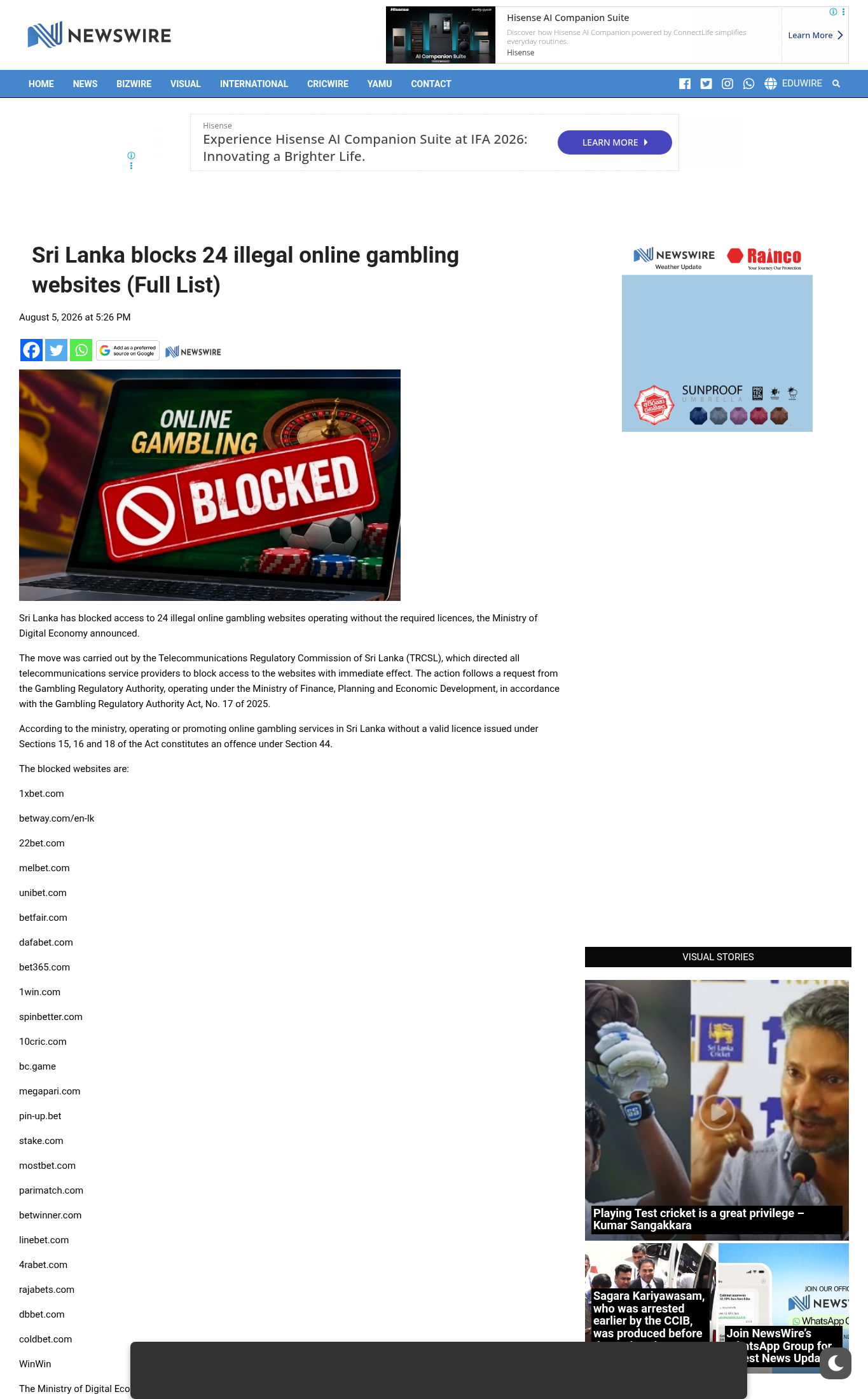
The central adverse record is a Newswire report dated 5 August 2026. It reports a Ministry/TRCSL order blocking 24 illegal online gambling websites and names the domains in the reported list. The supplied evidence packet identifies parimatch.com as the exact domain relevant to this review. This is stronger than a general warning about offshore gambling: it is a local account-access and enforcement signal tied to a particular hostname.
The report is evidence of what was reported about the order. It is not proof of every allegation a reader might associate with the service, and it does not by itself establish what happened to a particular customer’s money. It also does not tell us whether every network, date or access route produced the same result. Those limits matter. A block report should not be turned into an invented withdrawal story, but neither should it be treated as irrelevant to a Sri Lankan customer deciding whether to deposit.
| Question | Supported position | What remains unknown |
|---|---|---|
| Was the exact host named? | The supplied local report is recorded as naming the exact domain. | The packet does not provide a separate network-level test. |
| Was a Sri Lankan licence verified? | No current licence for the exact domain and operator was verified. | Any foreign or historic authorisation is not established here. |
| Was a withdrawal tested? | No account or payment test was performed. | Processing time, balance and outcome are unknown. |
Host, operator and licence must match
A legitimate-looking brand mark is not a licence certificate. The locally stored image used here is an exact-domain favicon reference and is expressly not evidence of safety or authorisation. It can help readers recognise the subject, but it cannot identify the legal entity accepting a Sri Lankan customer’s money.
The current identity position is therefore limited: the host under review is parimatch.com, while the operator is not verified in the current Sri Lankan record. No company name, registered address, licence number, licence period or regulator-issued domain mapping has been supplied for a precise host/operator match.
| Identity item | Current finding | Verification standard |
|---|---|---|
| Hostname | parimatch.com is the reviewed exact host. | Compare every character, including the ending of the domain. |
| Operator | Not verified in the current Sri Lankan record. | Find a regulator-linked legal entity, not only a footer or logo. |
| Local licence | No current Sri Lankan licence verified. | Match the licence to both entity and domain. |
| Licence expiry | No date supplied. | Confirm status directly in a current primary register. |
A different spelling, subdomain, mobile address, mirror or promotional link should not be assumed to be the same service. A clone can copy colours and wording while changing the destination. Conversely, a familiar domain name does not overcome an adverse local access record.
Is it legal or legitimate in Sri Lanka?
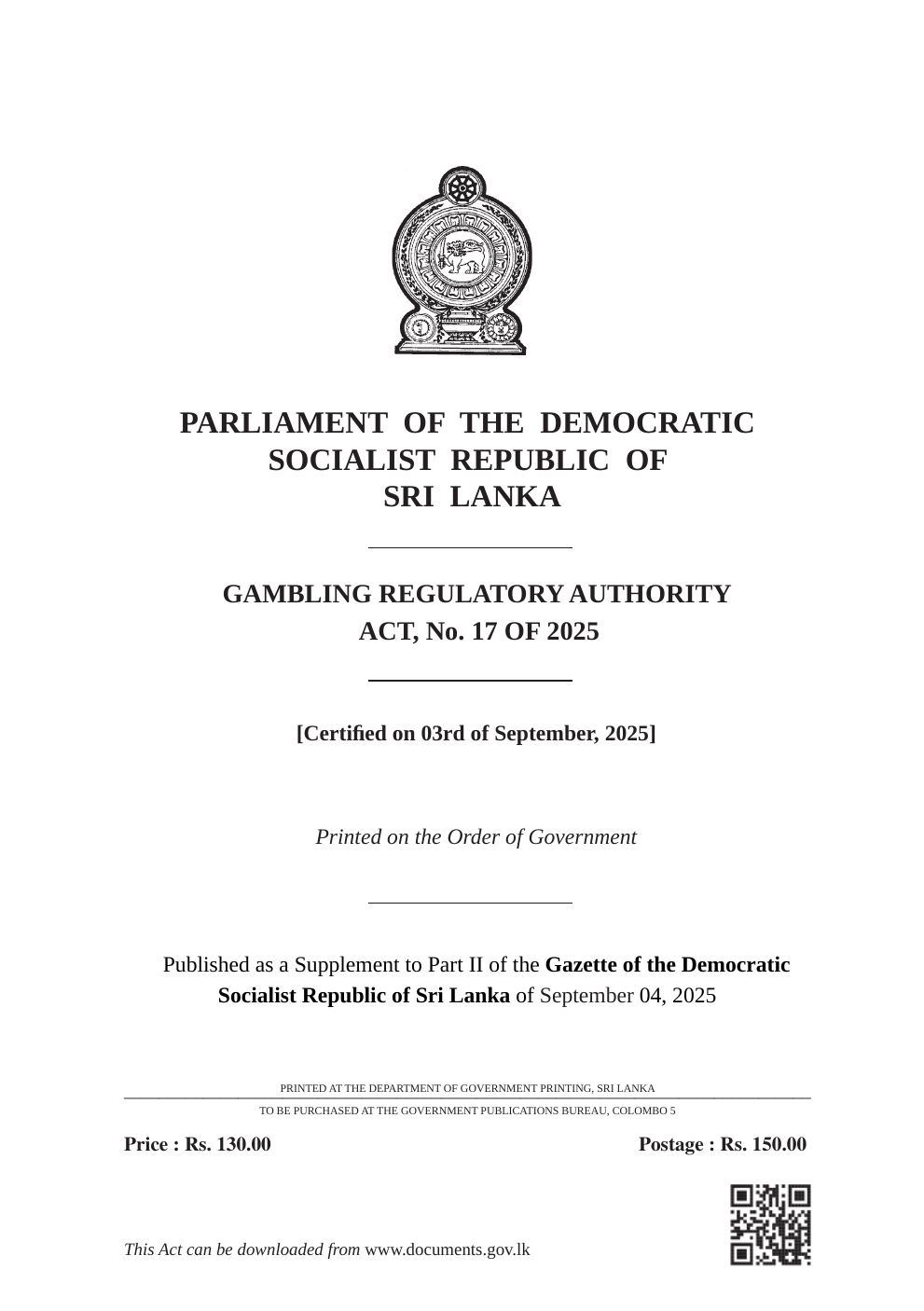
The supplied legal record is Act No. 17 of 2025. It establishes the Gambling Regulatory Authority and a local licensing framework. The Act is relevant context for the question “is it legal?”, but the supplied fact expressly says that it does not name this brand. It cannot be used to infer that the reviewed host holds a licence.
The evidence therefore supports a careful answer rather than a broad accusation. A current Sri Lankan licence has not been verified, and the exact domain is reported in a local block order. That is enough for a red safety signal and for a recommendation not to treat the host as locally authorised. It is not enough to invent a criminal finding against an unidentified operator or to state that every transaction has failed.
The Inland Revenue Department’s material describes the scope of betting and gaming levy rules, including internet bookmakers. Tax or levy coverage should not be confused with permission to operate. A service may be discussed in a tax framework without that discussion constituting a customer-facing gambling licence.
KYC and customer due diligence
Know-your-customer questions should be separated from the legal-status question. The Financial Intelligence Unit’s casino material describes anti-money-laundering and counter-terrorist-financing duties, including customer due diligence and a stated threshold. That official compliance context explains why a regulated gambling service may request identity information. It does not confirm that this host performs the required checks, that a particular customer passed them, or that documents submitted to an unverified service are protected in a particular way.
No KYC flow was tested for this review. There is no verified record of the documents requested, the identity of the reviewing entity, the retention period, the reason for a refusal or the result of any account review. Readers should not upload additional identity documents merely because a message promises faster access or a release of funds. First preserve the message, verify the destination independently and seek appropriate local advice if personal data or money is at risk.
| Evidence category | Available | Do not infer |
|---|---|---|
| KYC request | No tested account record supplied. | Do not infer that a request is genuine or legally sufficient. |
| AML/CDD framework | Official Sri Lankan compliance guidance is available. | Do not infer this host’s compliance from general guidance. |
| Identity result | No customer result supplied. | Do not claim approval, rejection or account closure. |
Payments, balances and withdrawals
There is no verified payment inventory for this review. No deposit method, currency route, card processor, bank channel, e-wallet, fee, minimum, processing time or withdrawal condition has been tested. The evidence packet also contains no account screenshot showing a balance. Accordingly, this review cannot promise that any payment method works, cannot label a transaction safe, and cannot claim that a withdrawal was withheld.
An inaccessible host creates a practical risk even before a dispute is proven. A customer may be unable to sign in, retrieve terms, download a transaction history or contact the service through the expected route. A screenshot of a balance would show only what was displayed, not that the balance is recoverable. Keep bank or wallet statements, transaction identifiers, timestamps, correspondence and the exact address used. Do not send a second payment to unlock a withdrawal without independent verification.
For general payment-risk checks, compare the name of the payment recipient with the verified legal entity, avoid sharing one-time authentication codes, and treat urgent “tax”, “verification” or “release” demands as unverified claims. None of these precautions proves what happened in an individual case; they reduce the risk of losing the records needed for escalation.
Clone and hostname checks
Before interacting with any gambling domain, copy the hostname into a note and inspect it character by character. Check whether the address uses the expected spelling, whether a link redirects elsewhere, and whether the payment page displays a different recipient. Do not rely on a search result, an advert, a social post or an image of a logo as proof of identity.
- Record the full address, date and time before entering credentials.
- Compare the address with the exact host being assessed.
- Check the named operator and licence against a current primary register.
- Save terms, transaction references and support messages before access changes.
- Stop if a mirror, shortened link or new recipient appears.
These checks cannot remove the reported local block. They are designed to prevent a second problem: confusing a clone or mirror with the domain named in the evidence.
Check first, then open the decision gateway
Complaint and escalation limits
If money, personal data or account access is involved, begin with a factual chronology: the exact host, dates, amount, payment rail, reference number, messages received and the last successful login. Keep originals and avoid editing screenshots. A complaint should state what can be evidenced and should distinguish an allegation from a confirmed outcome.
The available packet does not identify a verified Sri Lankan operator or a confirmed dispute-resolution body for this host. That means no reliable operator escalation route can be supplied here. A customer may need to contact the relevant payment provider about an unauthorised or disputed transaction, obtain independent legal or consumer guidance, and report suspected online harm through appropriate Sri Lankan authorities. Do not publish another person’s identity documents or accuse an unnamed person of fraud without competent evidence.
Our complaint guidance explains how to organise records. It does not guarantee recovery, create jurisdiction, or replace advice from a qualified local professional.
Chronology and evidence boundaries
| Date checked | Record | What it establishes |
|---|---|---|
| 2026-09-01 | Local report on the Ministry/TRCSL block order | Reports the order and the named domain list, including the exact host identified in the packet. |
| 2026-09-01 | Act No. 17 of 2025 | Establishes the Gambling Regulatory Authority and local licensing framework. |
| 2026-09-01 | FIU casino compliance material | Describes AML/CFT duties and the stated customer-due-diligence threshold. |
| 2026-09-01 | Inland Revenue Department levy material | Describes levy scope, including internet bookmakers. |
The sources have different roles. The local news report is the adverse domain record. The Act, FIU material and tax material are primary legal or official context. The logo reference is a recognition asset only. None supplies a tested account result, verified operator identity or withdrawal outcome. That separation prevents a general rule from being presented as a brand-specific fact.
For more detail on source grading, see our evidence methodology. Readers should also review the licence-check guidance before treating any online gambling host as locally authorised.
Conclusion: scam or legit?
The evidence does not support calling the service “safe” or “Sri Lankan licensed”. The precise host is reported in a local block order, no current local licence and matching operator have been verified, and no account or payment test was performed. The red signal is therefore a warning about the current evidence and access risk, not a fabricated claim about an individual balance or an unsupported criminal verdict.
If you are considering a deposit, pause until the exact domain, legal entity and current local licence can be matched in a primary record. If you already used the service, preserve evidence and contact your payment provider promptly about any transaction you do not recognise. Do not bypass a reported block through an unverified mirror. For responsible-play information, use responsible gambling guidance. Any future correction should identify the precise source, date, hostname and claim that changes.
Check first, then open the decision gateway
newswire.lk · fiusrilanka.gov.lk · ird.gov.lk · parliament.lk
Frequently asked questions
Is Parimatch a scam or legit in Sri Lanka?
The available evidence does not establish a personal fraud outcome, but it does report the exact host in a local Ministry/TRCSL block order. No current Sri Lankan licence or matching operator was verified, so the service should not be treated as locally authorised or low risk.
Is parimatch.com legally licensed in Sri Lanka?
No current Sri Lankan licence for parimatch.com and its operator was verified in the supplied record. The 2025 Act establishes a licensing framework, but it does not name this brand or prove that the host is licensed.
Was parimatch.com blocked in Sri Lanka?
The supplied dated local report says that the Ministry/TRCSL block order concerned 24 illegal online gambling websites and identifies the exact domain as part of the relevant list. No separate network test was performed for this review.
Can I recover a balance from the service?
No recovery outcome can be predicted. No account, balance or withdrawal test was supplied. Preserve transaction records and correspondence, contact the payment provider about any disputed transaction, and obtain independent local advice where appropriate.
Does KYC prove that an online gambling service is legitimate?
No. Official Sri Lankan AML/CFT material explains customer-due-diligence duties, but a KYC request does not prove that this host is locally licensed, that the recipient is genuine or that submitted documents will be handled safely.
How can I check for a clone or fake domain?
Compare every character of the hostname, inspect redirects and check the payment recipient against a verified legal entity. Do not rely on a logo, advert, social post or shortened link. Save the exact address and time before entering information.