Megapari review for Sri Lanka: blocked exact domain, no verified licence
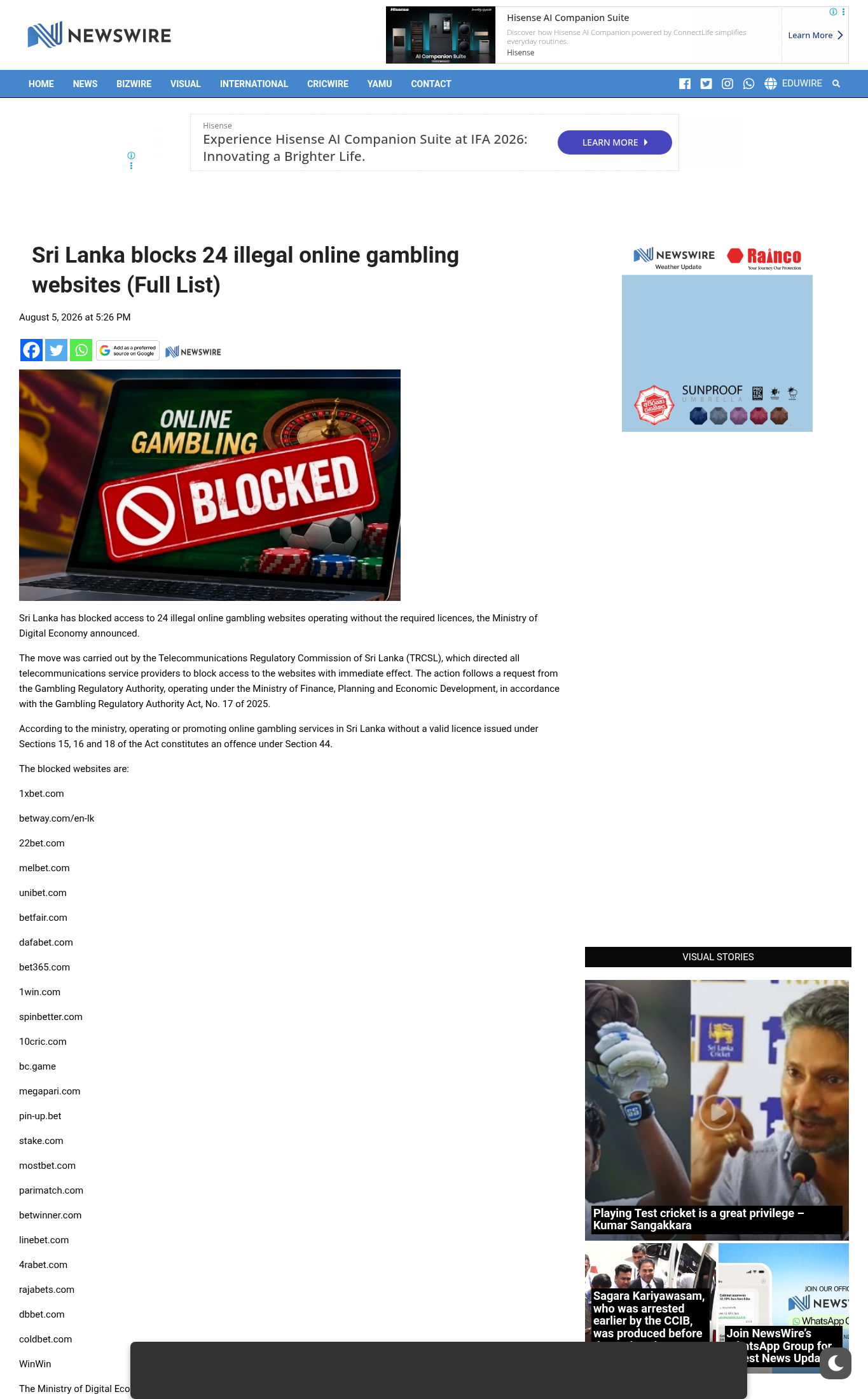
A vertical clip, a promo overlay, a tap: that is how most players in Sri Lanka first meet this bookmaker, and the advert almost never shows the address the tap finally resolves to. So the trail has to start at the destination rather than the offer. Two dated primary records settle the status question. Act No. 17 of 2025 sets up the local licensing framework, and an independent report dated 5 August 2026 describes a Ministry and TRCSL block order while publishing the full list of 24 named domains. The exact address behind the Megapari brand mark appears in that list, and that is why the grade here is red rather than amber.

From a phone advert to a real address
Every later check depends on knowing which host you actually reached. Shortened links, forwarded chat invitations and in-app browsers all hide the final hostname, and a mirror can look identical to the domain named in the block list while running on unrelated infrastructure. Three habits make the trail provable. Open the link in a full browser instead of an in-app view, so the address bar survives each redirect. Screenshot that address bar with the device date visible before typing anything. If the journey ends at a downloadable installer rather than a listed store entry, treat that channel as separate and unverified: nothing held here documents which files are served, who signs them or where they sit. A deposit sent to an address you cannot name afterwards is the hardest kind to escalate, because the first question anyone asks is which host took the money.
Hostname proof for the exact address
The record covers one named domain, not a brand and not every property showing the same logo. That cuts both ways: a near-match address is not automatically inside the reported order, and it is not safer for sitting outside it either, since no primary record attaches to it at all. Read the registrable part character by character, then the top-level domain, then check for added words, hyphens or numerals before the dot. Country-coded copies and .net, .live or .app variants circulate around every large betting brand and none of them inherit anything. What the current records support is narrow, and stating it plainly beats a rating out of ten.
| Item | Position held |
|---|---|
| Exact address checked | megapari.com |
| Brand mark | Exact-domain favicon, stored locally, operator tier |
| Operating entity | Not verified in the current Sri Lankan record |
| Current local licence | None verified; no number, no expiry date |
| Reported block status | Exact domain named in the list published 5 August 2026 |
| Payment, cash-out or verification test | None performed |
| Signal | Red, on corroborated adverse grounds |
Licence and operator: nothing on the local record
Two different findings often get collapsed into one, and separating them is the point of a graded assessment. The first is an absence: no local licence, no registered entity, no licence number and no expiry date is held for the brand or its exact address. Absence on its own would justify amber. The second is adverse and dated: the exact domain appears in a reported block order. The combination is what moves the grade to red. Footer company details, licence badges rendered in page furniture and jurisdiction claims in terms of service are operator statements; they are logged as claims, never promoted to primary evidence, and none are held for this address. Player reports from forums and comment threads sit lower again, useful as a pointer to what to check next but never proof of an outcome. The tier rules applied are set out in how assessments are graded.
What Act No. 17 of 2025 sets up
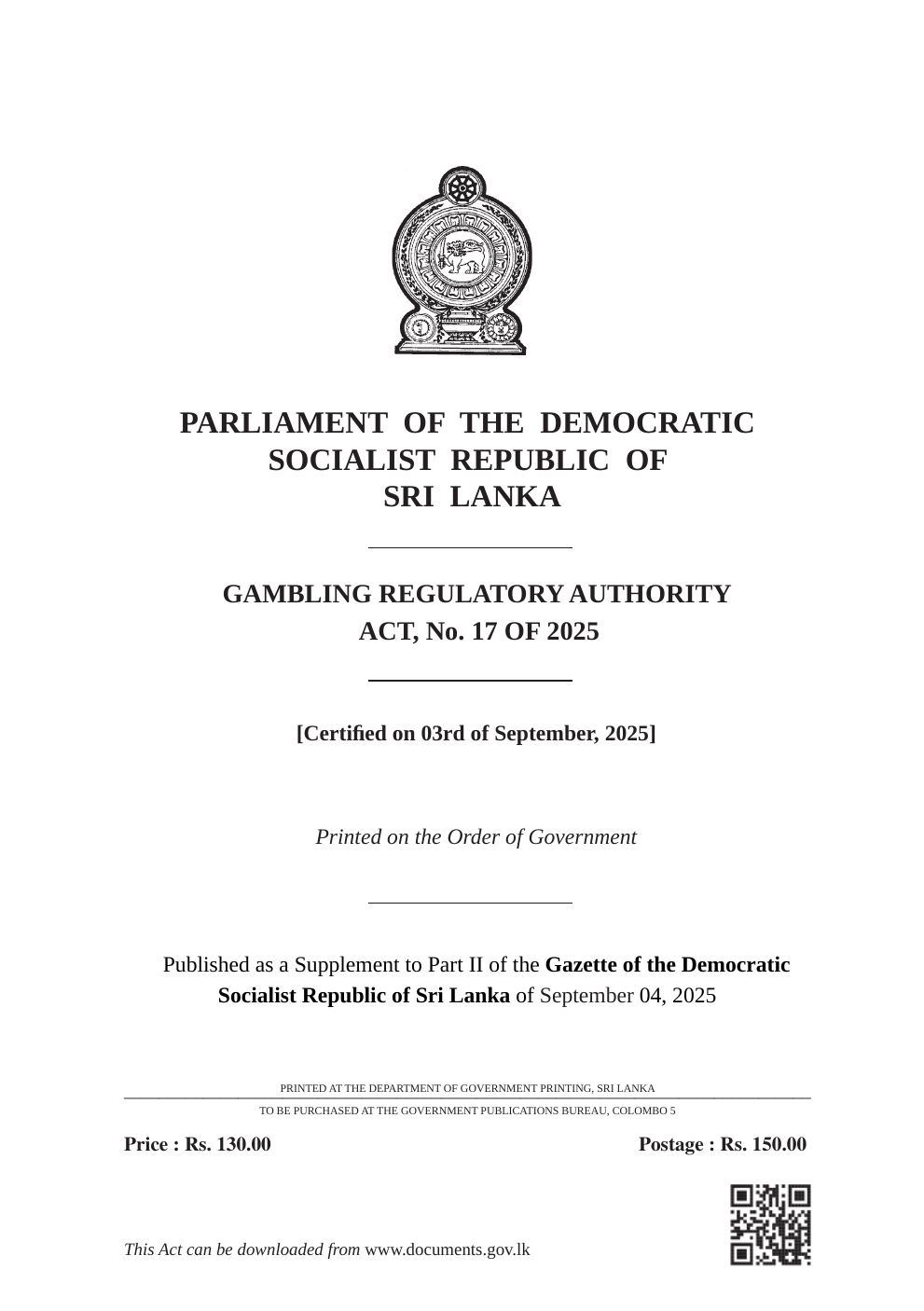
Sri Lanka moved from scattered ordinances to a single statutory regulator with Act No. 17 of 2025 as published by Parliament, which establishes the Gambling Regulatory Authority and a domestic licensing framework. For a player the consequences are structural rather than instant. A licence becomes something checkable against a named authority instead of something inferred from an image. Licence conditions, and therefore enforceable complaint rights, attach to a licensed entity. An address without a licence sits outside all of that, so the statutory protections are unavailable whatever the site's own terms promise. The statute names no individual brands and nothing in it approves or condemns this one; it is the yardstick against which a missing licence is measured. Practical steps for testing a licence claim are in the licence verification guide.
The block order reported on 5 August 2026
The adverse element comes from one dated report: an independent local outlet describing a Ministry and TRCSL instruction to block 24 illegal online gambling websites, with the full list of domains published alongside it in the 5 August 2026 report and list. The exact address for this operator is on that list. Three limits travel with the finding. The report is a media account rather than the underlying instrument, so the precise wording and scope of the order stay outside the record. A network-level block affects access, not the status of anything that happened before it: balances, pending cash-outs and stalled verification cases are untouched by it. And blocks get routed around, which is exactly how a player ends up on a mirror with no record attached to it. Access returning through a proxy, a VPN or an alternative address changes nothing about the underlying position.
| Record | Tier | Supports | Does not support |
|---|---|---|---|
| SL-ACT-2025 | Primary | The regulator and local licensing framework exist | Any statement about this brand |
| SL-BLOCK-2026 | Primary | The reported order and the 24 named domains | The gazette wording, or any payment finding |
| SL-FIU-CASINO | Primary | Sector due-diligence, record-keeping and reporting duties | That this operator is supervised |
| SL-IRD-BGL | Primary | Levy scope reaching internet bookmakers | That the operator is registered for it |
| LOGO-MEGAPARI | Operator | The mark used with the exact domain | Licence, ownership or safety |
Deposits and the payment path that was not tested
No account was opened, no deposit was sent and no cash-out was requested, so everything about payment behaviour here concerns what is missing rather than what happens. That limit is deliberate: an untested rail described in confident language is the commonest defect in operator write-ups. Rupee funding of offshore betting accounts also tends to travel through intermediaries, whether processor descriptors that do not match the brand, wallet top-ups, voucher codes or third-party agents, and every hop adds a party a complaint later has to name. Keep the deposit confirmation, the bank or wallet reference and the exact statement descriptor; those artefacts, not screenshots of a balance, are what an authority can work with. Rail-by-rail risks are covered in the payment methods guide.
| Claim class | Record required | Status |
|---|---|---|
| Rupee deposit rails | Processor confirmation plus a dated transaction record | Not held |
| Statement descriptor | Bank or wallet statement line from a completed deposit | Not held |
| Cash-out timing | Request and settlement timestamps for one account | Not held |
| Fees and limits | Dated capture of current terms plus a matching settlement | Not held |
| Failed-deposit refunds | Documented case with operator correspondence | Not held |
| Crypto routing | On-chain reference tied to an account credit | Not held |
Cash-outs, verification and the money-laundering threshold
Sri Lanka's financial intelligence framework treats casinos as designated non-financial businesses with customer due-diligence, record-keeping and reporting duties, including a published threshold above which identification is mandatory, as set out in the Financial Intelligence Unit guidance for the casino sector. Those duties bind institutions inside the domestic supervisory net, and nothing held places this operator inside it. That gap is what a player feels at cash-out. Verification requests can arrive at any point and in any order, with no supervised standard governing which documents are demanded, how long they are kept or how a refusal is appealed. Source-of-funds questions, selfie checks and repeated re-uploads are ordinary across the industry and are not themselves signs of bad faith; the missing accountable forum when they stall is the risk being flagged. Cash-out windows, caps and fees for this address are unverified and are not quoted as figures.
Tax, the levy and who owes it
The betting and gaming levy applies to bookmaking and gaming businesses and its scope expressly reaches internet bookmakers, per the levy scope published by the Inland Revenue Department. The obligation sits with the business rather than the punter, but the scope matters for a second reason: an operator taking Sri Lankan custom online without a local licence and without levy registration stands outside both the licensing and the fiscal frameworks, and each is a place where a documented complaint can be lodged. Personal questions about tax on winnings depend on individual circumstances and are not answered here. No levy registration, tax number or filing record for the brand or its exact address is held, and none is assumed from silence.
Check first, then open the decision gateway
Complaints, escalation and what to capture first
With no local licence there is no domestic dispute service holding jurisdiction over the account, which changes what escalation can realistically achieve. Authorities act far more readily on access, tax, advertising and money-laundering angles than on recovering one player's balance. Build the file before writing to anyone: a submission naming the exact host, the dated address-bar screenshot, the payment descriptor, the amount, the timestamps and the operator's own replies is triaged differently from one saying a betting site refused to pay. Keep original transcripts and email headers rather than summaries. Intake steps are in the complaint guide.
| Issue | Realistic route | Limit |
|---|---|---|
| Unpaid or delayed cash-out | Operator channel first, then a dated file kept for any authority or payment-provider dispute | No local licence conditions to enforce |
| Suspected laundering exposure | The sector reporting framework operated by the Financial Intelligence Unit | Targets institutions, not individual balances |
| Levy or registration concerns | Inland Revenue Department | Fiscal outcome, not player restitution |
| Access and blocking questions | The Ministry and TRCSL channels named in the reported order | Affects availability only |
| Gambling harm | Urgent help and self-exclusion options | Offshore addresses honour local schemes inconsistently |
Mirror and lookalike checks before logging in
Because the reported order attaches to named domains, mirror traffic is where most avoidable losses start. Six checks take about a minute.
- Retype the address by hand instead of following a forwarded link, then compare it letter by letter with the domain in the published list.
- Confirm the certificate name matches the registrable domain you typed rather than a redirect target.
- Refuse any page that asks you to install a certificate, dismiss a browser warning or sideload a file to continue.
- Treat a login form reached from an email or chat message as untrusted until you have retyped the address yourself.
- Compare promotion terms against the terms served at the address you typed; mirrors often carry stale or invented offers.
- Screenshot the address bar and the date at first deposit, so any later complaint can show which host you used.
Risk register, unknowns and the evidence trail
Ranked by likelihood of costing a player money: losing access with a funded balance while a block is in force; verification stalling with no supervised appeal; paying through an intermediary that leaves a descriptor nobody will match to the account; and mirror capture, where credentials and deposits reach a property with no record at all. Against that sit the open unknowns, which are real: no dispute outcome, no cash-out test, no entity record and no gazette text are held, so nothing here alleges fraud by any named person or company.
| Date | What entered the record | Tier |
|---|---|---|
| 2025 | Act No. 17 of 2025 establishes the Gambling Regulatory Authority and domestic licensing | Primary |
| 5 August 2026 | Independent report of the Ministry and TRCSL order naming 24 domains, including the exact address | Primary |
| 1 September 2026 | Sector due-diligence duties, levy scope and the exact-domain mark re-checked; no licence record found; no payment test run | Primary and operator |
How the red grade was set
Red requires an official adverse record or corroborated documented evidence. The trigger here is the dated report of a block order naming the exact domain, read against a licensing statute that address cannot satisfy. Amber would apply if the licence were merely unverified. The grade describes legality and recourse in this market, not a proven finding of non-payment.
Correction path
Documented corrections are welcome and are logged with dates. A licence record from the Gambling Regulatory Authority naming both the entity and the exact address, or evidence of removal from the block list, would change the grade. Send records through the editorial contact route; the standards applied are published in the editorial policy.
The grade attaches to this address, not to betting generally. If you intend to stake anyway, weigh the graded options in the operator list, read the deposit-limit and harm-reduction notes, and use the routed link only after checking the destination yourself: Check first, then open the decision gateway.
Questions players ask
Is Megapari a scam or legitimate for players in Sri Lanka?
Nothing held here proves fraud, and no dispute outcome or refused withdrawal is documented. What is documented cuts a different way: the exact domain is named in a reported block order and no local licence exists, so a dispute has no domestic forum. The grade is red on legality and recourse, not on a proven non-payment finding.
Is it legal for me to use the service from Sri Lanka?
The framework created in 2025 licenses operators domestically, and the reported order targets sites treated as illegal in the market. Your own position depends on your circumstances and belongs with a qualified lawyer rather than an evidence grade. What is certain is that an unlicensed address leaves you with no licence conditions to rely on.
The address still loads on my phone, so is it permitted?
No. Blocking is applied at network level and lands unevenly across mobile and fixed providers, and it is routinely bypassed by proxies, VPNs and mirrors. Reachability is a fact about your connection, not a status finding. The record that counts is the dated list of named domains, which is unaffected by whether a page opens.
Are cash-outs paid on time?
Unknown, and deliberately not guessed. No account was opened and no withdrawal was requested, so no timing, cap or fee is quoted. If you already hold a funded balance, request it in writing, keep the timestamps, save the descriptor shown by your bank or wallet, and preserve the full transcript rather than a summary.
How do I tell the exact address from a mirror?
Retype the address yourself, compare the registrable part character by character with the domain published in the list, then confirm the top-level domain and the absence of added words, hyphens or numerals. Check that the certificate name matches what you typed. Refuse any page asking you to install a file or dismiss a security warning.
What would move the grade away from red?
Two things, each documented and dated: a licence record from the Gambling Regulatory Authority naming the operating entity together with the exact address, or evidence that the domain has been removed from the block list. Operator statements, badges and footer text would be logged as claims and would not by themselves shift the grade.