Linebet in Sri Lanka: licence and safety review
Bottom line for Sri Lankan users
The key issue is not whether a page using the Linebet name can be reached from Sri Lanka. It is whether the exact host, the legal operator behind it and the licence presented to a customer all match a current Sri Lankan record. On the evidence available for this review, they do not.
The exact domain linebet.com is reported in a 2026 local report about a Ministry and Telecommunications Regulatory Commission of Sri Lanka (TRCSL) order blocking 24 online gambling websites. The report names the domains on the list and is the adverse evidence relevant to this review. The current packet does not contain a Sri Lankan licence record for Linebet, and the operator has not been verified in the Sri Lankan record.
That produces a red signal for local eligibility and risk assessment. Red here means that the exact domain is linked to an official adverse action through corroborating local reporting, not that every statement made by the brand has been proven false. No account was opened, no deposit was made and no withdrawal or identity-verification test was performed.

Why the exact host matters
A brand name is not the same thing as a legal entity or an authorised website. A customer may encounter a main domain, a regional subdomain, a redirected address, a mirror or a lookalike host. Those addresses can display similar colours and marks while being controlled by different parties. For that reason, a licence claim should be checked against the complete hostname and the named operator, rather than against a logo or a search result.
| Item to match | What this review establishes | What remains unknown |
|---|---|---|
| Brand | The supplied materials identify the brand as Linebet. | Whether every site using the name is controlled by one entity. |
| Exact domain | linebet.com is the domain assessed here and is named in the reported block-list coverage. | Whether a redirected or mirror address has a different legal status. |
| Operator | Not verified in the current Sri Lankan record. | Legal name, registered address, company number and accountable management. |
| Licence | No current Sri Lankan licence was verified. | Any foreign authorisation and whether it permits service to Sri Lankan residents. |
Before entering credentials, read the address bar character by character. Watch for added words, hyphens, unusual top-level domains, spelling changes, shortened links and redirects that end at a different host. A matching favicon proves only that an image is associated with a domain; it does not authenticate the operator.
What the Sri Lankan block evidence says
The dated local report is the most important adverse item in the packet. It reports that the Ministry and TRCSL blocked 24 illegal online gambling websites and names the exact domains covered. The record supplied for this review attributes the inclusion of linebet.com to that reported order. The report is not treated as proof of every possible allegation about the service; its precise relevance is the reported blocking action and domain identity.
Blocking also does not answer every question about ownership, customer balances or foreign regulation. It does, however, make it unsafe to describe the exact host as a normally verified Sri Lankan-licensed service. Attempting to bypass a block can introduce additional technical, payment and consumer-protection risks. A working mirror should not be assumed to be an approved replacement for the named domain.
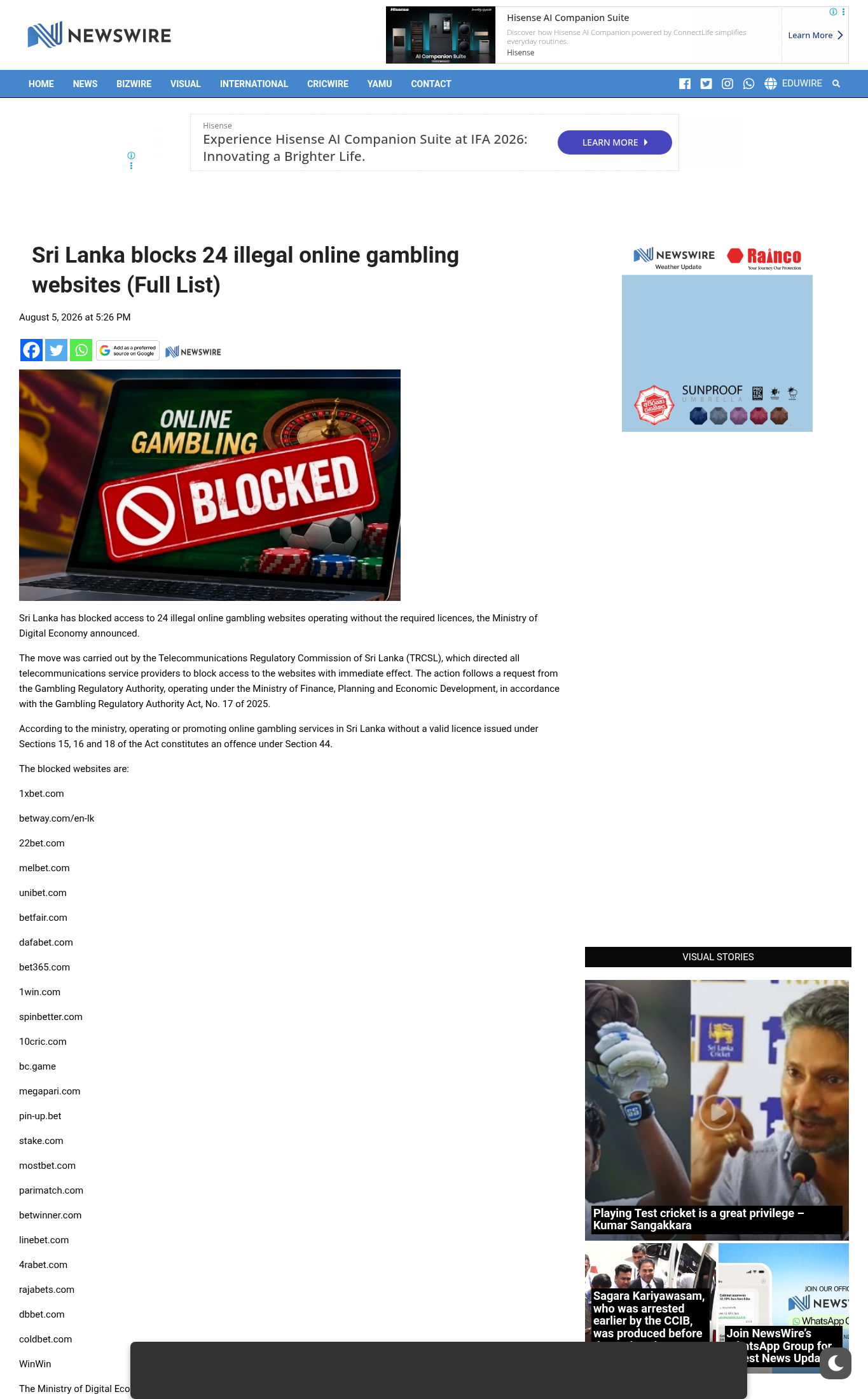
Read the dated local block-list report for the source context. The link is provided so readers can distinguish the reported government-related action from an unsupported warning or an anonymous user comment.
Licence and legal-status check
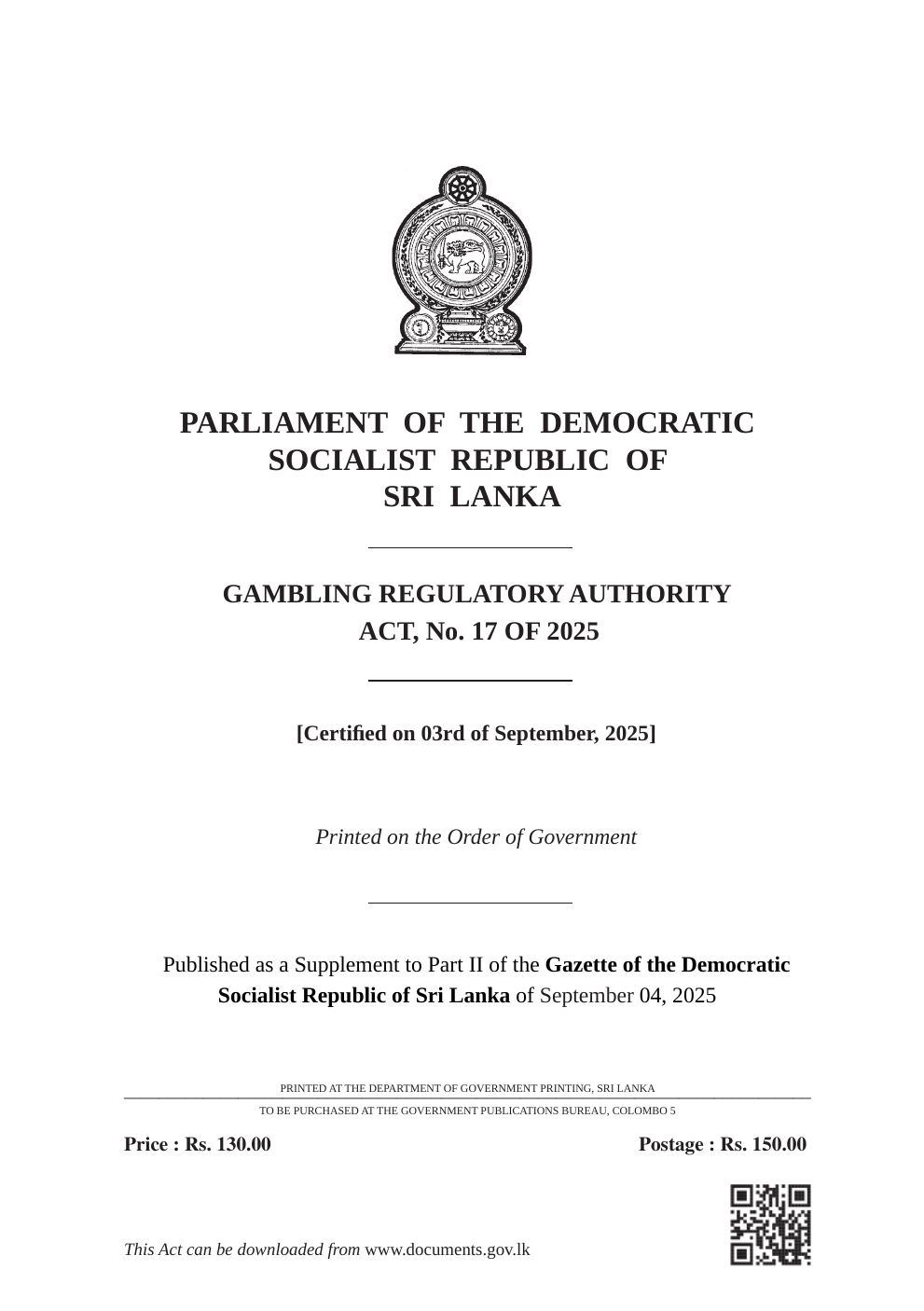
Act No. 17 of 2025 establishes the Gambling Regulatory Authority and a local licensing framework. That legislation is relevant because it describes the regulatory structure against which a local authorisation should be checked. It does not, in the supplied evidence, name Linebet or establish that linebet.com holds a licence.
The correct conclusion is therefore limited: no current Sri Lankan licence was verified in the record supplied for this review. This is different from claiming that no licence exists anywhere in the world. A foreign licence, if one were claimed, would still need its exact legal holder, scope, status, domain coverage and customer jurisdiction to be checked. None of those details has been verified here.
| Question | Evidence-based answer | Safe interpretation |
|---|---|---|
| Is there a verified Sri Lankan licence? | None was verified in the current packet. | Do not present the service as locally authorised. |
| Does the 2025 Act name Linebet? | No such naming is established by the supplied record. | The Act provides a framework, not a brand-specific approval. |
| Is the exact domain reported as blocked? | Yes, the supplied local report names the relevant domains and the record attributes linebet.com to the order. | Treat access and local eligibility as adverse issues. |
| Was the service tested? | No account or payment test was performed. | Do not infer performance, solvency or withdrawal reliability. |
Read the supplied 2025 Act record when checking the framework itself. The document is not used as a substitute for a current, entity-specific licence lookup.
Operator identity is still open
The operator is recorded as not verified in the current Sri Lankan record. That gap matters because a customer needs to know which legal party accepts funds, processes identity checks, holds account data and answers a dispute. A brand page alone cannot establish those facts.
Look for a full legal name, incorporation jurisdiction, registered office, licence number, regulator and terms that connect those details to the exact host. Then compare them with an authoritative register, checking spelling and status rather than relying on a badge. If the name in the terms differs from the name in a licence claim, treat that as an unresolved identity mismatch. If the operator is disclosed only through a generic support address or an unconnected company, the complaint route is correspondingly weak.
No legal entity, corporate address, licence number or responsible company has been invented in this review. The absence of verification is itself material: it prevents a confident host-to-operator-to-licence match.
Payments and withdrawal risk
No payment method was verified and no transaction was tested. It would therefore be misleading to list a card, bank transfer, wallet or cryptocurrency as available, reliable or suitable for Sri Lankan users. Payment icons can change by country, account status and time, and a method shown before registration may disappear when a withdrawal is requested.
| Stage | What should be checked | Status in this review |
|---|---|---|
| Deposit | Named payment recipient, currency, fees, limits and whether the account holder must match. | Not tested. |
| Account funding | Whether funds go to the disclosed operator or an unexplained intermediary. | Unknown. |
| Withdrawal | Processing conditions, source-of-funds checks, maximum delays and reversal rules. | Not tested. |
| Dispute | Which legal entity receives a written complaint and which regulator can review it. | Operator route not verified. |
Keep payment confirmations, timestamps, transaction references, account correspondence and screenshots if money has already been sent. Do not pay an additional “release”, “tax”, “verification” or “unlocking” amount merely because a message demands it. Such a demand cannot be assessed as genuine from this evidence packet, and sending more money can increase the loss.
The tax context is also separate from authorisation. The Inland Revenue Department describes the scope of betting and gaming levy, including internet bookmakers. A tax or levy reference does not turn a named website into a licensed operator, nor does it guarantee that a customer can recover funds.
Check the official levy information for the tax framework. It is cited for scope only, not as approval of the service.
KYC, AML and personal-data caution
Identity checks can be legitimate in regulated gambling, but a request for a passport, national identity card, selfie, bank statement or proof of address should be connected to a clearly identified operator and a transparent privacy process. Here, the accountable Sri Lankan operator has not been verified. That makes it prudent to pause before uploading sensitive documents.
The Financial Intelligence Unit explains AML/CFT duties and customer due-diligence thresholds relevant to casinos and designated businesses. Those duties show why an operator may ask questions about identity or source of funds; they do not prove that this particular host follows them. Nor do they establish where documents are stored, who can access them or how long they are retained.
Review the Financial Intelligence Unit guidance to understand the official AML/CFT context. Do not treat general compliance guidance as a Linebet compliance certificate.
If documents have already been submitted, record what was sent, when, to which address and in response to which request. Change reused passwords, monitor payment accounts and be alert to follow-up impersonation. This is practical risk reduction, not a finding that a data breach occurred.
Scam-or-legit conclusion without overclaiming
“Scam” is often used to mean several different things: a fake clone, an unlicensed service, a delayed withdrawal, identity theft or a website that simply does not accept a customer’s jurisdiction. The supplied evidence does not establish a completed fraud, a failed withdrawal or a specific victim allegation. It does establish a serious local eligibility warning and an unverified operator identity.
Accordingly, the evidence-led answer to “is Linebet scam or legit in Sri Lanka?” is not a blanket criminal accusation. The service cannot be verified as a Sri Lankan-authorised operator on the current record, and the exact domain is reported as blocked. Those facts are sufficient to advise against treating it as a locally cleared service. A future authoritative licence record could change the licensing assessment, but it would need to identify the same domain and legal entity.
Check first, then open the decision gateway
Clone and redirect checks
Use a short verification sequence before trusting any address that presents the brand:
- Copy the full hostname without clicking through a shortened link.
- Compare the spelling, ending and security certificate details with the address you intended to visit.
- Check whether the terms name the same legal operator throughout.
- Match any licence number and domain against an authoritative regulator record.
- Stop if a mirror claims that bypassing a block makes the service legal.
- Never use a logo, favicon, bonus message or social-media endorsement as proof of authorisation.
A clone check cannot turn an adverse block report into a positive approval. Its purpose is narrower: preventing a customer from sending credentials or money to an address that is not even the exact host under review.
Complaint route and preserving evidence
For a suspected payment, access or identity problem, first preserve the account identifier, relevant hostnames, dates, amounts, payment references and complete correspondence. Keep original files where possible and avoid editing screenshots. Do not publish another person’s personal data while documenting a dispute.
Ask the service, if contact is still available, for the legal operator, written reason for any restriction, withdrawal timetable and formal complaints address. A response from an unverified support channel is not independent confirmation. If money or identity documents are involved, consider reporting the matter to the appropriate Sri Lankan authorities and your payment provider. A complaint is an allegation unless a dated competent-source record establishes what happened.
Use the site’s complaint guidance for evidence organisation and escalation options. It does not guarantee recovery and does not replace an official investigation.
Methodology, chronology and correction path
This dossier separates primary records from brand-identification material. The evidence chronology is straightforward: the 2025 Act supplies the regulatory framework; the Financial Intelligence Unit material supplies AML/CFT context; the Inland Revenue Department material supplies levy context; and the dated 2026 local report supplies the adverse exact-domain block evidence. The supplied favicon is used only to identify the brand mark.
| Evidence role | Used for | Not used for |
|---|---|---|
| Primary government or parliamentary material | Regulatory framework, AML/CFT context and levy scope. | Claiming a Linebet licence without a brand-specific record. |
| Dated local report | Reporting the Ministry/TRCSL block-list action and exact-domain naming. | Proving every allegation or a completed customer loss. |
| Brand asset | Visual identification of the supplied brand. | Proving ownership, safety or authorisation. |
| Testing | None performed. | Claims about deposits, withdrawals, support or KYC outcomes. |
The signal is red because the adverse domain evidence is corroborated by the supplied local record and no current Sri Lankan licence or operator match was verified. If an authoritative record later identifies linebet.com and its legal operator under a current Sri Lankan licence, send the source, date and exact domain match for review. Corrections should distinguish a changed fact from a disagreement with the cautious interpretation.
Practical decision for readers
Do not confuse a reachable page, a familiar brand mark or a payment prompt with local approval. On the present evidence, the safer decision is to avoid treating linebet.com as a verified Sri Lankan service, avoid bypassing the reported block and avoid submitting identity documents until the operator and licence can be independently matched. Readers seeking broader comparisons can review the evidence methodology and use the licence-check guidance to examine the host-to-entity connection.
If you nevertheless choose to inspect the service, do not assume that access means eligibility, that a displayed method guarantees withdrawal, or that a foreign address provides Sri Lankan consumer protection. Gambling can cause financial harm. Visit responsible-gambling guidance and seek urgent support through urgent-help resources if gambling is affecting safety, finances or wellbeing.
Check first, then open the decision gateway
Frequently asked questions
Is Linebet legal in Sri Lanka?
No current Sri Lankan licence for Linebet was verified in the supplied record, and linebet.com is reported in a 2026 local block-list report. The service should not be treated as Sri Lankan-authorised on this evidence.
Does the block report prove that Linebet is a scam?
No. It establishes a reported adverse block action involving the exact domain, but it does not prove a completed fraud, failed withdrawal or particular customer loss. It is nevertheless a serious warning about local eligibility and risk.
Who operates Linebet?
The operator was not verified in the current Sri Lankan record. No legal entity, registered address or entity-to-domain licence match should be inferred from the brand mark or website name.
Were Linebet deposits or withdrawals tested?
No. No account, deposit, withdrawal or payment test was performed. Payment methods, fees, processing times and withdrawal reliability are therefore unknown.
Should I upload identity documents?
Pause until the operator, exact host and applicable licence are independently verified. If documents were already submitted, preserve the request and submission details, change reused passwords and monitor relevant accounts.
Where can I complain about a problem?
Preserve account, payment and correspondence records, request a written response from the service and use the complaint guidance linked in this review. Consider contacting your payment provider and the appropriate Sri Lankan authorities where money or identity documents are involved.