BetWinner in Sri Lanka: block status, licence and risks

Verdict for Sri Lanka: red. The decisive concern is not an expired licence date. No current Sri Lankan licence has been verified for betwinner.com, while a dated local report says the exact domain was included in a Ministry and Telecommunications Regulatory Commission of Sri Lanka (TRCSL) blocking order covering 24 online gambling websites. That combination leaves no verified local validity window in which Sri Lankan users can treat the service as locally authorised.
The red signal is based on corroborated adverse evidence, not on a claim that every customer was defrauded. The available packet does not prove how every deposit, wager or withdrawal was handled. It does establish a substantial domain-specific regulatory risk and an absence of verified local operator and licence details. No account registration, deposit, withdrawal or identity-check test was performed.
Current validity window and evidence verdict
A licence-expiry watch normally starts with an issuing authority, licence number, named legal entity, covered domain and expiry date. None of those elements has been verified here for a current Sri Lankan authorisation. There is therefore no expiry date to monitor and no safe grace period to infer. An overseas-looking badge, certificate number or footer statement would not fill that gap unless it can be matched to a competent regulator’s current record and to the exact host being used.
| Check | Verified position on 1 September 2026 | Practical meaning |
|---|---|---|
| Exact domain | betwinner.com is named in the reported list of blocked domains | Domain-specific adverse evidence applies |
| Sri Lankan licence | None verified | Do not assume local authorisation |
| Local operator | Not verified in the supplied records | Accountability and complaint routing remain unclear |
| Licence expiry | No verified date | No validity window can be calculated |
| Payment test | Not performed | Deposit and withdrawal performance are unknown |
The practical conclusion is narrower than calling the brand a universal scam, but stronger than a neutral caution: Sri Lankan users face a reported exact-domain block and cannot rely on a verified local licence. Review the general licence-check procedure before trusting any later claim that the status has changed.
Exact host, operator and licence match
Three identifiers must align before a positive licensing conclusion is justified: the domain in the browser, the legal entity holding the account contract and the licence record maintained by the relevant authority. A similar name, mobile mirror, shortened link or differently spelled host is not an equivalent match. Even a genuine brand mark proves only visual identity; it cannot establish which company receives funds or which regulator supervises the account.
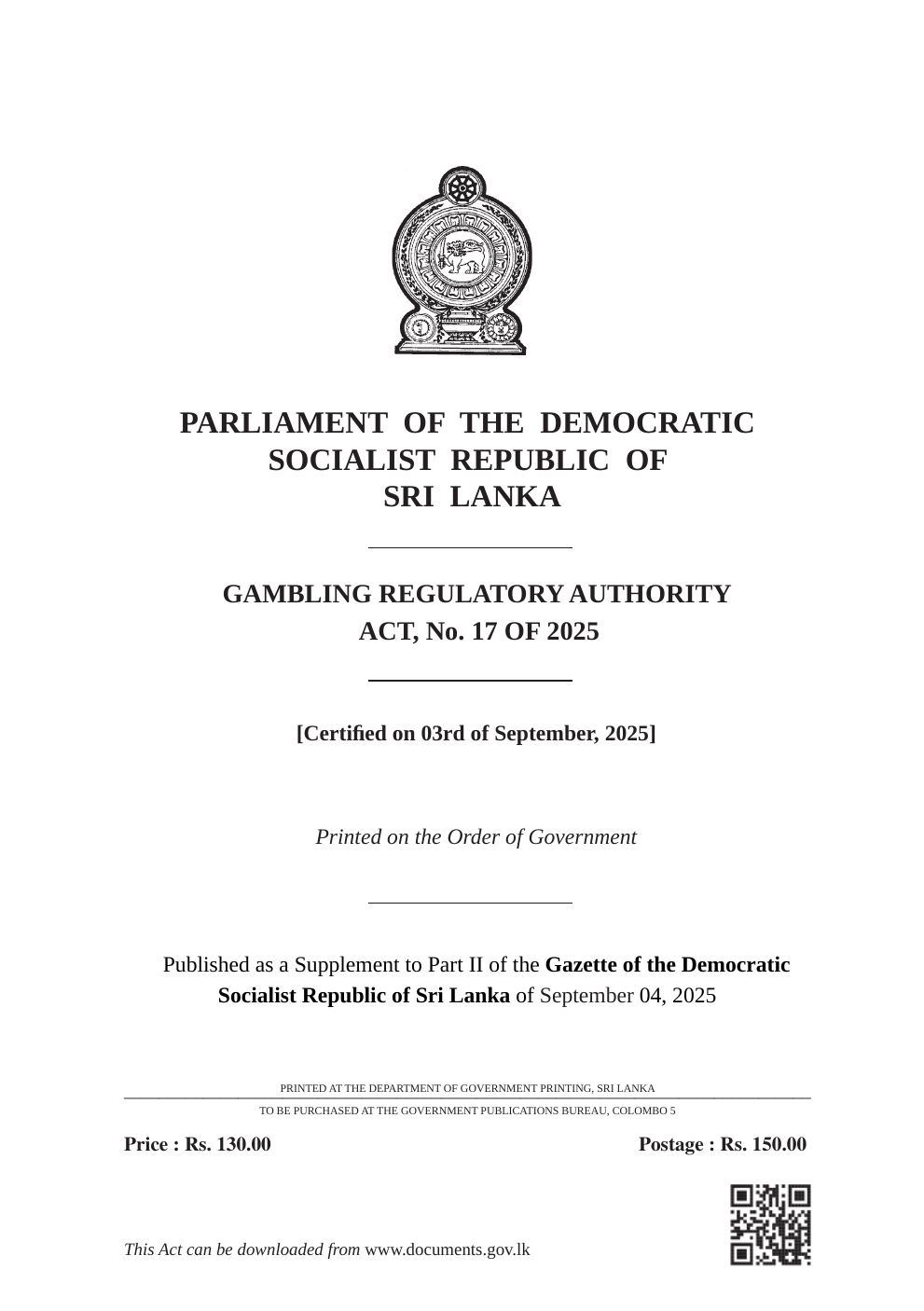
The current records identify the exact domain in adverse reporting but do not identify a verified Sri Lankan licensee operating it. Act No. 17 of 2025 establishes the Gambling Regulatory Authority and a local licensing framework. The Parliament record for Act No. 17 of 2025 supports the existence of that framework, but it does not name BetWinner, approve its domain or supply a licence number for it.
Users encountering another address should not transfer the conclusion automatically. Check the full hostname, including spelling and top-level domain, and record where the link originated. A mirror may introduce additional impersonation or payment risk, while a newly presented host requires its own regulator and ownership match.
What the reported block establishes
The dated Newswire report attributes the action to the Ministry and TRCSL and lists 24 domains, including the exact reviewed domain. Its significance comes from that precise domain match and its stated official basis. The reported Sri Lankan blocking order and full domain list is the adverse record supporting the red signal.
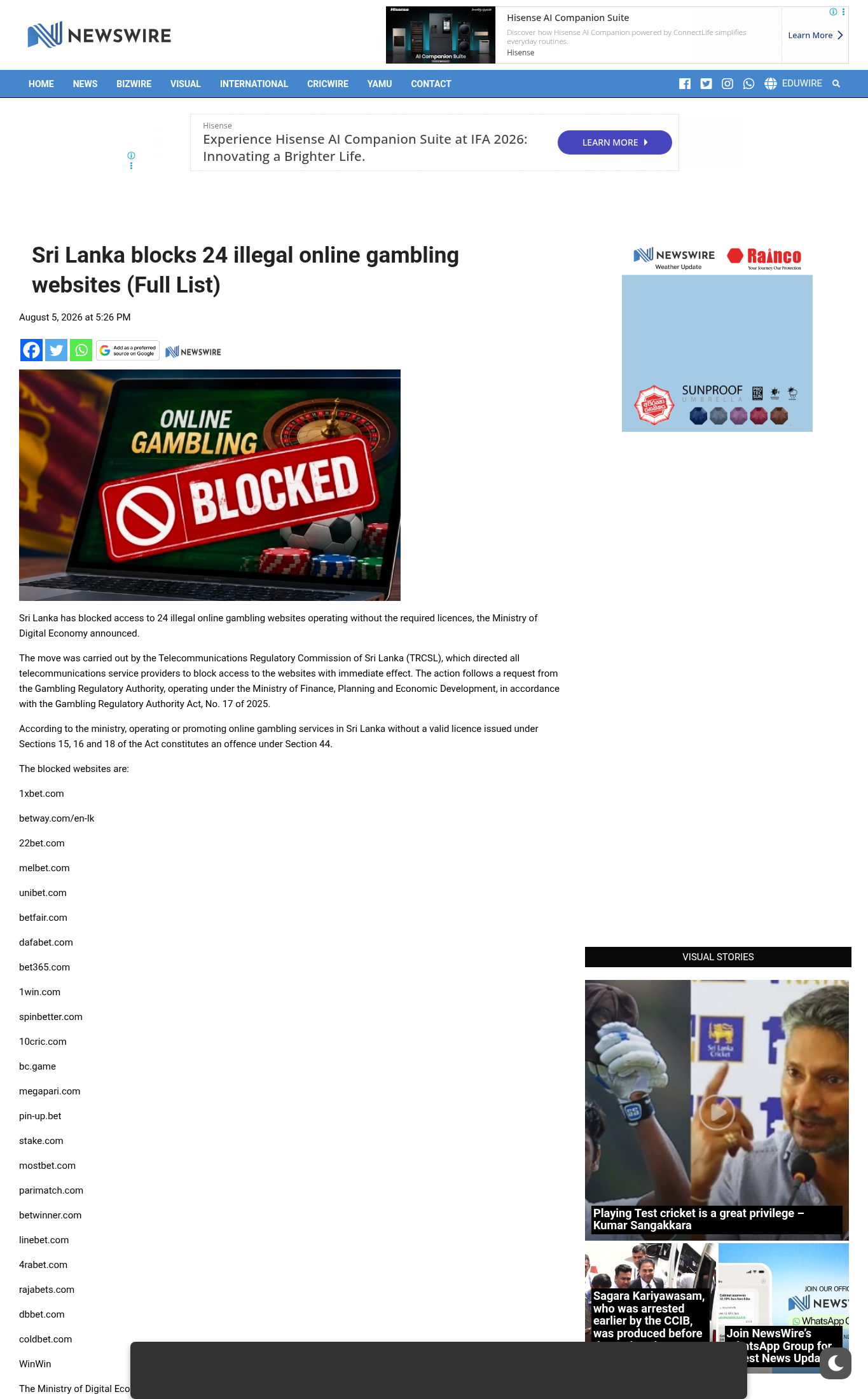
A block report does not prove that every transaction was dishonest, that every related domain is controlled by the same entity or that every user will experience identical access. It also does not reveal whether funds held before the order remain recoverable. It does, however, make ordinary access unreliable and weakens the practical routes available to a Sri Lankan customer seeking local accountability.
| The evidence supports | The evidence does not support |
|---|---|
| The exact domain was reported among 24 blocked websites | A finding that every customer was scammed |
| The action was attributed to the Ministry and TRCSL | A verified balance, payout or account outcome |
| No current local licence was supplied or verified | A claim about an unlisted mirror or app |
| A red domain-level risk signal | A criminal finding against an identified operator |
Legal status in Sri Lanka
The available primary materials show that Sri Lanka has a statutory regulatory framework and that betting and gaming taxation can extend to internet bookmakers. The Inland Revenue Department’s betting and gaming levy guidance describes the levy’s scope. Tax scope is not a substitute for gambling authorisation: being potentially subject to a levy does not prove that a particular website holds permission to accept a Sri Lankan customer.
For the exact service reviewed, no local licence number, licensed company or expiry date is established. The reported blocking order adds specific adverse context. Accordingly, the service should not be described as legally verified for Sri Lanka. Users should also avoid interpreting access through a different network, application or mirror as evidence of legality; technical availability and regulatory approval are different questions.
No conclusion is made here about an unidentified overseas licence because the packet contains no accepted regulator record for one. Even if an overseas authorisation were later produced, it would need verification and would not automatically override Sri Lankan requirements or the reported local block.
Payments, deposits and account records
No payment method, local bank route, card acceptance rule, cryptocurrency option, fee schedule or deposit limit has been verified. Displayed cashier choices can vary by account, location and intermediary, so they should not be inferred from general brand advertising. The absence of a payment test also means there is no evidence that a successful deposit can be withdrawn through the same channel.
If money has already been sent, preserve a complete record before taking further action. Useful material includes the date and time, amount, currency, recipient descriptor, transaction reference, payment-provider receipt, account identifier, relevant terms and all support correspondence. Screenshots should include the full address and timestamp where possible. Do not edit originals; retain copies separately.
| Record to preserve | Why it matters | Safe next step |
|---|---|---|
| Bank or wallet receipt | Shows amount, date and recipient descriptor | Ask the provider what dispute route applies |
| Account ledger | Compares deposits, bets, bonuses and balance | Export or capture it before access changes |
| Terms shown at deposit | Records conditions presented at the time | Keep the complete text and address |
| Support messages | Shows requests, promises and response timing | Maintain a dated chronological log |
| Identity-document request | Records what sensitive data was sought | Verify necessity before sending more data |
Do not pay an additional “release”, “tax”, “verification” or “unlock” charge merely because a message says it is required. The evidence packet does not validate such charges. Consult the payment-risk guide for recordkeeping and provider-contact steps.
Withdrawals and KYC: what remains unknown
There is no verified withdrawal test, processing-time sample, rejected-payout record or confirmed fee. It would therefore be misleading to promise fast withdrawals or to state that payouts always fail. Treat any quoted time as an operator claim unless a transaction record demonstrates the actual result for a defined request.
Identity verification may be relevant in regulated gambling and anti-money-laundering controls. The Financial Intelligence Unit’s casino AML/CFT and customer due-diligence guidance describes duties and a customer due-diligence threshold in the casino context. It does not establish that the reviewed domain follows those duties, nor does it authorise the service.
Before providing identity material, users should know the verified legal recipient, purpose, retention terms and secure submission route. Never send passwords, one-time passcodes or remote-access credentials. If documents were already supplied and misuse is suspected, secure the associated email account, change reused passwords, alert relevant financial providers and monitor statements. A KYC request by itself neither proves legitimacy nor proves fraud; the unresolved operator identity and blocked-domain report make careful verification especially important here.
Check first, then open the decision gateway
Complaint route and timing
Start with a concise written complaint only if the account channel remains accessible. State the account identifier, disputed amount, transaction references, requested resolution and a reasonable response deadline. Avoid threats or unsupported accusations. Save the submitted text and any acknowledgement. If access is blocked or support does not resolve the matter, contact the payment provider promptly because dispute windows may be limited by the provider and payment type.
- Stop further deposits while the dispute is unresolved.
- Preserve the account ledger, payment evidence, terms and correspondence.
- Send one clear written complaint and request a reference number.
- Ask the bank, card issuer or wallet provider about applicable dispute procedures.
- Record suspected impersonation, altered payment details or unauthorised transactions separately.
- Use the complaint preparation guide to organise the chronology.
The packet does not identify a verified locally licensed operator or a brand-specific Sri Lankan complaint officer. It would be unsafe to invent one. Urgent unauthorised-payment or identity-theft concerns should be raised with the relevant financial provider without waiting for a casino response. Gambling-related distress warrants immediate support through urgent-help resources.
Clone, mirror and impersonation checks
A blocked address may lead users to search for alternative links, increasing exposure to clones and unverified mirrors. Do not treat a familiar colour scheme, favicon, spelling or promotional message as ownership evidence. A copied logo can be reproduced easily, and the stored logo above is included solely to identify the reviewed brand.
| Check | Warning sign | Response |
|---|---|---|
| Hostname | Extra words, substituted letters or unfamiliar suffix | Do not sign in or pay |
| Account contract | No clear legal company or address | Do not assume brand accountability |
| Licence claim | Badge without a regulator-side exact-domain match | Verify through the authority record |
| Payment recipient | Personal account or unrelated descriptor | Pause and question the provider |
| Support request | Password, one-time code or remote access | Refuse and secure the account |
Never reuse credentials from an existing gambling account on an alternative host. If the same password was entered on a suspicious mirror, change it anywhere it was reused and enable stronger account protection. No conclusion about a mirror should be derived from the exact-domain evidence without a separate ownership and regulatory check.
Evidence chronology, limits and correction path
The chronology is straightforward but incomplete. Act No. 17 of 2025 created the Gambling Regulatory Authority and local licensing framework. On 5 August 2026, the local report described a Ministry/TRCSL block order and included the exact domain in its list. The full packet was checked on 1 September 2026. The tax and FIU materials supply legal and compliance context but do not license or endorse this service.
The assessment uses domain specificity, source competence, date and claim scope. The legislation is primary evidence for the framework. The FIU and Inland Revenue Department records are primary evidence for their stated compliance and tax subjects. The block finding relies on a dated independent local report attributing the order to public authorities. The logo is operator-context material only. No user report, personal experience or unsupported complaint determines the verdict.
A correction could be warranted if a competent Sri Lankan authority publishes a current record naming the legal entity, licence number and exact domain, or if the reported block attribution is formally corrected. Marketing copy, a fresh mirror, continued technical access or an undated licence image would not be enough. Evidence can be submitted through the correction contact route, with the source and date clearly identified. The wider scoring rules are available in the evidence methodology.
Check first, then open the decision gateway
Frequently asked questions
Is BetWinner legit in Sri Lanka?
No current Sri Lankan licence has been verified for the exact domain. A dated local report also includes betwinner.com in a Ministry/TRCSL blocking order, so it receives a red risk signal rather than a legitimacy endorsement.
Does the red signal prove that every user was scammed?
No. It reflects a reported exact-domain block and the absence of verified local licensing and operator details. The records do not establish every customer’s transaction outcome or prove that every related address has the same ownership.
Is there a licence expiry date to check?
No verified Sri Lankan licence or expiry date was supplied. Without an authority record matching the legal entity and exact domain, no validity window or grace period can be calculated.
Are deposits and withdrawals verified?
No. No account, deposit or withdrawal test was performed, and the packet does not verify payment methods, fees, processing times or payout success. Preserve transaction records and do not send extra funds to release a disputed balance.
Does a KYC request prove the operator is regulated?
No. Customer due diligence can be part of regulated AML/CFT controls, but a document request does not itself prove licensing or safe handling. Verify the legal recipient, purpose and secure channel before sharing sensitive material.
What should I do if money is already stuck?
Stop further deposits, save the account ledger and payment evidence, submit a concise written complaint and ask your payment provider about dispute options promptly. Do not share passwords or one-time codes and do not pay an unverified release fee.