Betway in Sri Lanka: block-order record and licence chronology
What changed on 5 August 2026
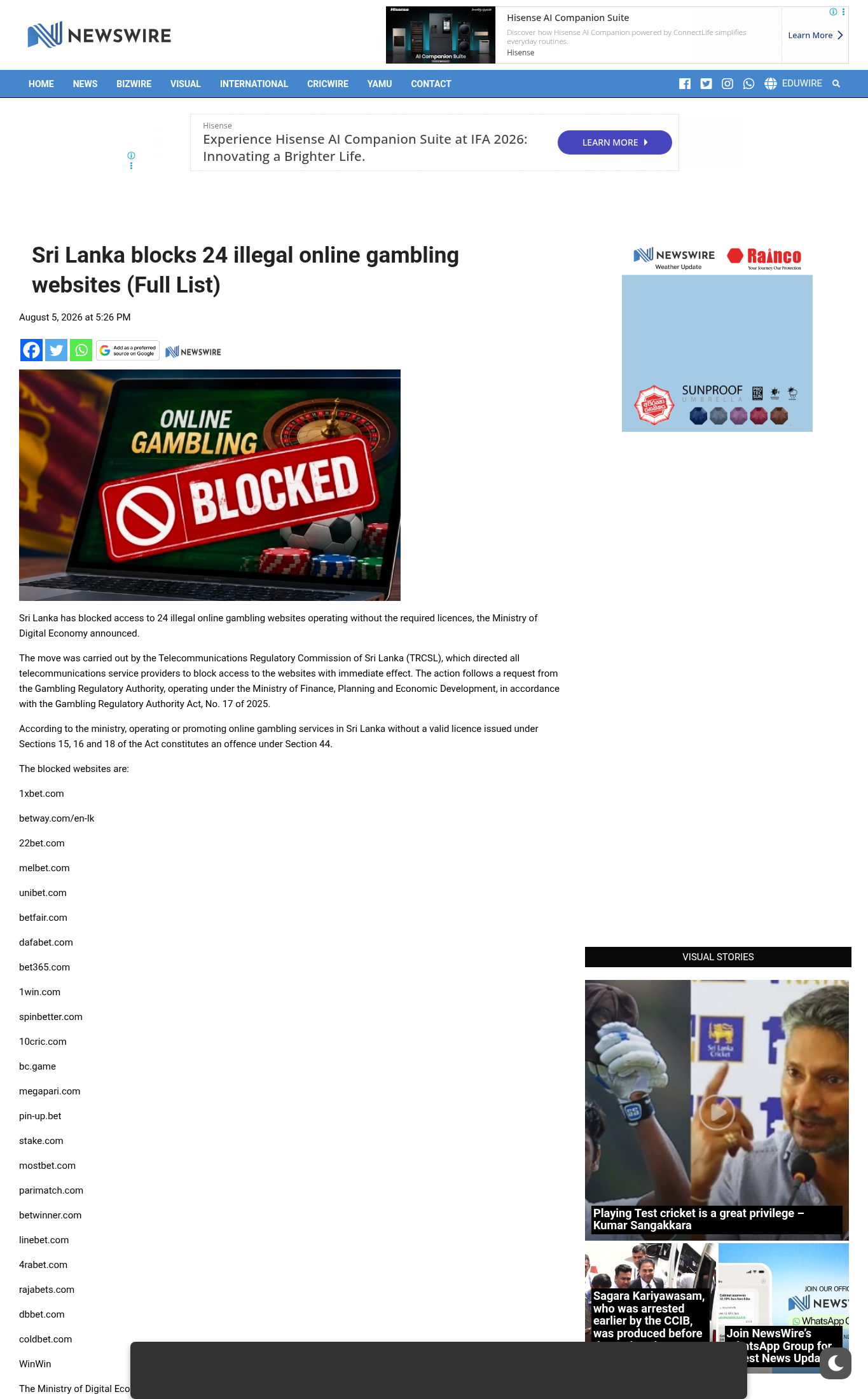
The reading of this operator's Sri Lankan address turns on one dated item. On 5 August 2026 an independent Sri Lankan outlet published the full list of 24 online gambling addresses covered by a block instruction attributed to the Ministry and the Telecommunications Regulatory Commission of Sri Lanka. The local address betway.com/en-lk is named in that reported list: the 5 August 2026 report naming all 24 blocked addresses.
Two conclusions follow, and only two. The exact address is reported as sitting on an official block list, which is an adverse item against that precise host rather than a general verdict on conduct in other markets. And nothing in the ledger shows a Sri Lankan licence held by that address before, during or after the instruction. The report is journalism describing an administrative act, so the naming of the 24 addresses is the checkable element; the wording of the instruction itself was not inspected.
| Date | Record | Source ID | Tier | What it establishes |
|---|---|---|---|---|
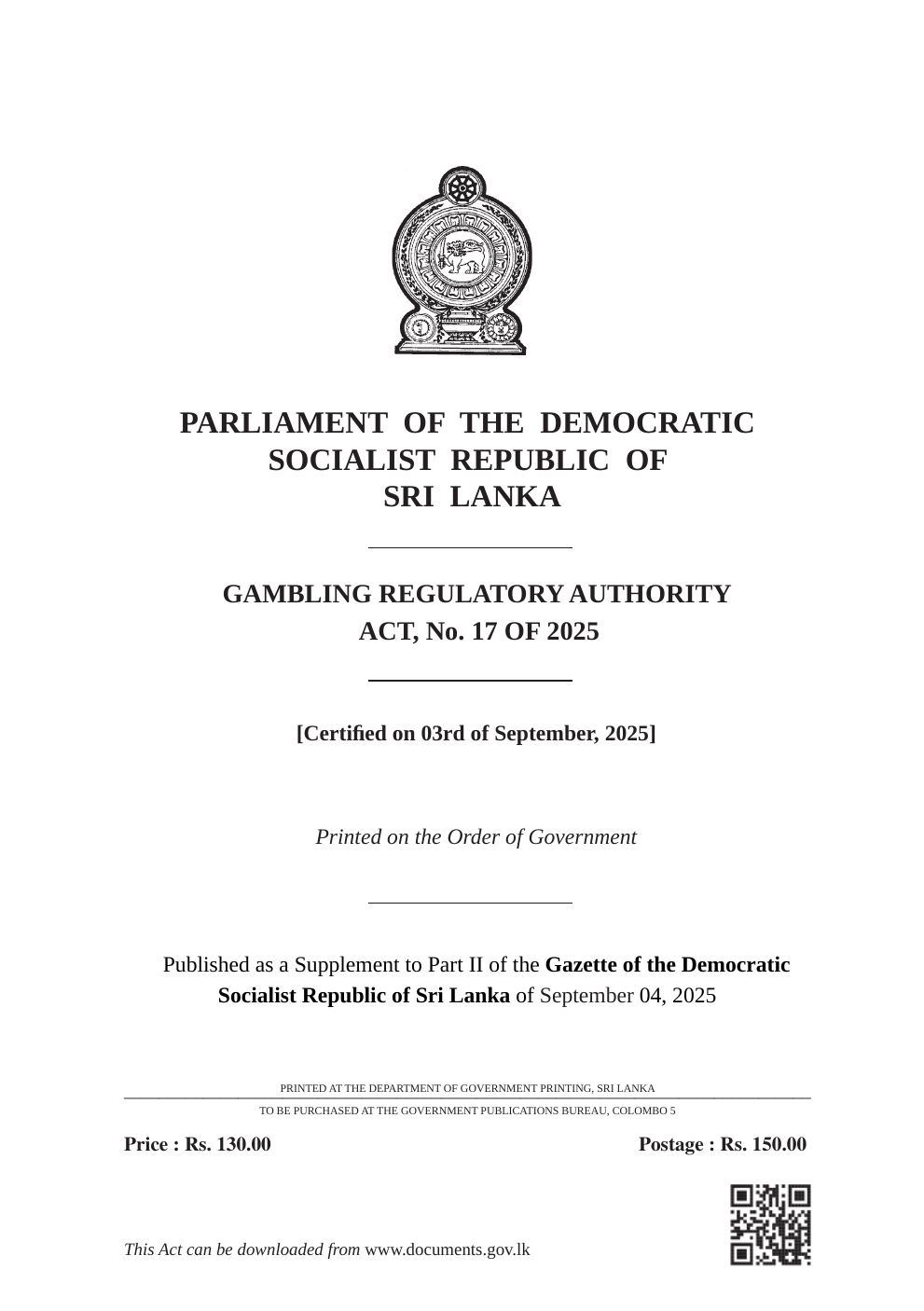
| 2025 | Act No. 17 of 2025 | SL-ACT-2025 | Primary | Gambling Regulatory Authority and a local licensing framework exist |
| 2026-08-05 | Report of a Ministry and TRCSL block instruction naming 24 addresses | SL-BLOCK-2026 | Primary | The exact local address is named in the reported list |
| 2026-09-01 | Ledger sources re-checked | All | Primary and operator | No local licence document for the address was found in the packet |
| None | Deposit, wager or withdrawal test | None | None | Nothing; no test was run |
Host and brand-mark match for the Betway address
Verification starts with a character-by-character comparison of the registrable domain and the locale path segment, not with the look of the pages. The mark stored alongside these findings is a 256-pixel favicon taken from the exact registrable domain and saved locally. It identifies the brand for readers and proves nothing about authorisation, ownership or payout behaviour, because a favicon can be copied in seconds. That is why it sits in the operator tier and never above it.

What does carry weight is narrow: the host string exactly as it appears in the dated list, the certificate subject the browser reports for that host, and whether the locale path matches. If a search advert, messaging forward or installer reaches a different registrable domain, even one rendering identical pages, the dated record does not describe it and neither does anything below.
Entity map: what the record names and what it leaves blank
Keeping named parties apart from blanks is the difference between a dossier and a guess. The packet names an address string, a statute, tax guidance and anti-money-laundering guidance. It does not name a Sri Lankan licence number, a locally licensed company, directors, a local payment processor, or any local body currently accepting disputes about this trading name. The reported instruction lists addresses rather than companies, so attributing the address to a specific legal entity would be invention. Where the brand holds authorisations in other jurisdictions, those documents were not supplied here, and in any case a foreign licence is not local permission.
| Check | Value in the record | Status |
|---|---|---|
| Exact local address | betway.com/en-lk | Named in the reported block list |
| Local licence number | None supplied | Not verified |
| Locally licensed entity | None supplied | Unknown |
| Licence expiry | Not applicable | No licence to date |
| Regulator listing | No authority listing supplied | Not verified |
| Brand mark | Exact-domain favicon, stored locally | Operator tier only |
Licensing and levy scope after Act No. 17 of 2025
Sri Lanka is not a market without rules for remote betting. Act No. 17 of 2025 establishes the Gambling Regulatory Authority and the framework under which local permissions are issued: the text of Act No. 17 of 2025. The statute sets the frame and does not mention this trading name, and no permission issued under it appears in the packet. Separately, the Inland Revenue Department sets out the betting and gaming levy and its scope, which reaches internet bookmakers: the departmental levy guidance.
Read together, the two records show that remote bookmaking is treated locally as both licensable and taxable. The open question is therefore not whether the activity can be authorised, but whether this particular address sits inside that system. No supplied document places it there.
Unlicensed, blocked or fraudulent: three different findings
The common search is whether this brand is a scam. Three findings get confused in that one word, and they need separating. A fraud finding requires documented, dated evidence of dishonest conduct or an adjudicated outcome; the packet contains none, so no such claim is made here. An unlicensed finding means no local permission has been verified, which is the position for this address today. A blocked finding means an access instruction has been reported against the host, which is what the 5 August 2026 list shows.
The red signal rests on the second and third findings together, not on the first. Practically, the risk is remedy rather than proven dishonesty: money placed with a host that no local authority licenses leaves a player outside local enforcement, whatever the operator's record elsewhere. If a compared entry with a current primary record is the more useful next step, the checked list is here.
Check first, then open the decision gateway
Deposits and payment exposure while the block order stands
No deposit method, currency support, fee schedule or processing rail is verified for this address, so none is described. What can be set out is the exposure created by the two established facts. Access instructions typically push players towards workarounds, and using one to reach a blocked host can conflict with an operator's own terms while leaving no local body to appeal to. Card and bank rails may decline or reverse unpredictably where a merchant is subject to a local instruction, and a declined or held transfer that involves an unlicensed host has no domestic dispute forum attached to it. General method comparisons for this market sit under payment methods and risks.
| Claim area | Ledger support | Status |
|---|---|---|
| Deposit methods offered | None | Unverified |
| Rupee account support | None | Unverified |
| Withdrawal processing time | None | Unverified |
| Withdrawal limits | None | Unverified |
| Fees and conversion charges | None | Unverified |
| Completed payout test | None | Not performed |
Withdrawals: the payout test that was never run
No account was opened, no funds were deposited, no bet was placed and no cash-out was requested against this address. Because the host carries a reported access instruction and no verified local permission, opening one would also be the wrong step to take. The consequence is stated plainly: no payout speed, refusal rate, hold pattern or limit can be reported for Betway in this market, and any figure circulating elsewhere without a document chain behind it should be treated as unsourced.
A payout test that would justify changing the picture needs a specific chain: a timestamped deposit receipt, a wagering record, a withdrawal request with its own timestamp, the credited-funds timestamp on the receiving account, and captures of each step tied to the exact host. Anything short of that is anecdote. The same standard applies to a player's own experience submitted to us; documents move a finding, recollections do not.
Identity checks and anti-money-laundering duties
Sri Lanka's Financial Intelligence Unit publishes the anti-money-laundering and counter-terrorist-financing obligations that apply to casinos as designated non-finance businesses, including customer due diligence above a stated transaction threshold: the unit's guidance for casino businesses. The threshold figure is not restated here; read it at the source, which is the only version that stays current.
Those duties bind operators inside local supervision. A host that has not been verified as locally licensed sits outside that perimeter, so a player cannot assume equivalent identity checks, record-keeping or reporting discipline, and cannot rely on a domestic supervisor to compel document handling. In practice, expect identity and address requests to arrive at withdrawal rather than registration, expect source-of-funds questions on larger movements, and keep an independent copy of every document sent, with dates. Where records exist only on the operator's side, a dispute becomes very hard to evidence.
Check first, then open the decision gateway
Where a complaint can go with no named local licensee
With no local permission and no licensee named in the record, there is no domestic licence number to complain against, which is the most consequential practical effect of the current position. The realistic ladder starts with the operator's own support, always in writing, with ticket references and screenshots kept outside the account. If a card or bank rail was used, the payment provider's dispute process is the next avenue, and it runs on transaction evidence and deadlines rather than on gambling law.
Questions about whether any permission has since been issued belong with the authority created under the 2025 statute, and questions about the access instruction itself belong with the bodies named in the 5 August 2026 report. Dated documents can be sent to us through the complaints route or the contact page. If gambling itself has become the problem rather than one operator, start with urgent help, self-exclusion and responsible gambling tools.
Clone, mirror and lookalike checks before any login
Access instructions reliably produce imitations, and this address is now an attractive target for them. Five checks take under a minute. Compare the registrable domain character by character against the string in the dated list, watching for inserted hyphens, doubled letters and alternative endings. Check the certificate the browser reports for the host actually loaded, not the one the link promised. Refuse installer files offered outside an official application store. Treat a paid search result as an advertisement rather than as a verified address. And remember that a matching logo means nothing, because the mark shown above is itself only a copied favicon.
Two habits reduce the damage if a copy is reached anyway: never reuse a password that protects an email or banking account, and never send identity documents to a host that failed the domain comparison. The step-by-step routine is set out under how to check a licence and a host.
Risk register, method and the correction path
| Risk | Basis in the record | What would reduce it |
|---|---|---|
| No domestic remedy for a dispute | No local permission verified | A dated licence document naming the exact host |
| Access interruption mid-session | Reported access instruction of 5 August 2026 | Documented removal of the address from the list |
| Unknown payout behaviour | No test and no supplied payout evidence | A dated, complete deposit-to-credit chain |
| Imitation addresses | Access instructions attract lookalikes | Exact host and certificate comparison |
| Unclear levy standing | Levy scope covers internet bookmakers | Evidence of local levy registration |
Method, stated so it can be argued with: every ledger source was re-checked on 1 September 2026; primary records, operator material and user context were kept in separate tiers and never merged; no account was opened; a green signal would require current primary evidence naming the exact host, and red requires an official adverse record or corroborated documented evidence. Here the corroboration is a dated independent report naming the precise address in an official instruction, paired with the absence of any verified local permission. The limits are equally explicit: the statute does not name the brand, and the instruction text was not read directly.
Corrections are welcome and are handled on documents alone. A licence certificate, an authority listing, a removal notice or a complete payout chain, each dated, will move the finding. Send them through the contact page. The standards applied are set out under our methodology and editorial policy, and other entries in the market sit under reviewed operators.
Questions players in Sri Lanka ask
Is Betway legal to use in Sri Lanka right now?
No local permission has been verified for the exact address, and that address is named in a reported block instruction dated 5 August 2026. On the current record the service is unlicensed locally and reported as blocked. Legality of a player's own conduct is a question for a qualified Sri Lankan lawyer, not for a dossier.
Does the reported block instruction prove the operator is a scam?
No. The record supports an unlicensed and blocked finding, not a finding of dishonesty. No dated complaint decision, court outcome or documented non-payment case appears in the packet, so no fraud claim is made. The practical risk is the absence of a local remedy rather than proven misconduct.
Can withdrawal times or limits be quoted for this brand?
No. No deposit, wager or withdrawal was carried out and no payout documents were supplied, so every timing, limit and fee figure remains unverified. A quoted number without a dated deposit-to-credit chain behind it should be treated as unsourced, wherever it appears.
What identity documents should a player expect to be asked for?
Nothing specific is verified for this operator. Requests generally arrive at withdrawal rather than registration and cover identity, address and, on larger movements, source of funds. Because the host is outside verified local supervision, keep independent dated copies of everything sent and never send documents to an address that failed a host comparison.
Where does a complaint go when no local licensee is named?
Start in writing with the operator's support and keep the ticket references. If a card or bank rail was used, raise a dispute with that provider under its own deadlines. Questions about licensing belong with the authority created by the 2025 statute, and dated documents can be sent to us through the complaints route.
What would change the red signal?
A dated licence document or authority listing naming the exact host, or documented removal of that host from the reported block list. Either would be re-checked and dated before the finding moved. Absent one of those, the signal stays red regardless of advertising, application listings or a familiar logo.