Bet365 in Sri Lanka: Domain, Licence and Block Check
Verdict: red. Start with the address bar, not the logo. A copied colour scheme, familiar icon or search result can lead to a lookalike domain that has no demonstrated relationship to the service. The exact host considered here is bet365.com. A Sri Lankan report dated 5 August 2026 names that domain among 24 online gambling websites covered by a Ministry/TRCSL blocking action. The record packet does not verify a current Sri Lankan licence or a locally accountable operator for it.
That combination answers the practical question “is Bet365 scam or legit in Sri Lanka?” more carefully than a universal label. The supplied evidence does not establish that every activity associated with the international brand is fraudulent. It does establish a serious local warning: the exact domain was reported blocked, while no current Sri Lankan authorisation for the domain and entity has been demonstrated. Users in Sri Lanka should not treat access, advertising or a functioning sign-in screen as proof of legality.
1. Test the domain before trusting the branding
Clone defence begins by reading the complete hostname. The relevant evidence concerns bet365.com, not a spelling variation, extra word, different ending, shortened link, social-media account or application download page. Even an exact-looking logo cannot bridge that gap. A clone may copy visual assets while directing deposits or identity documents to an unrelated recipient.
| Check | What to inspect | Why it matters |
|---|---|---|
| Hostname | Read every character before the first single slash after the domain | Added words, hyphens or altered endings can indicate a different site |
| Connection | Confirm the browser shows an encrypted connection | Encryption protects transit but does not prove legitimacy or licensing |
| Payment recipient | Compare the displayed merchant with any independently verified legal entity | An unexplained recipient weakens accountability and recovery options |
| Licence claim | Match the domain, legal entity, jurisdiction and current status | A licence belonging to another company or market does not authorise this host in Sri Lanka |
Do not assume that a mirror is safer because the main address does not load. A new address offered through a message, group or advertisement may be unrelated, and the evidence packet supplies no approved alternative host. Do not bypass a network restriction to reach a mirror. Use the licence-check procedure before considering any gambling service.
2. What the Sri Lankan block evidence says
The adverse record is a dated local report attributing the blocking direction to the Ministry and the Telecommunications Regulatory Commission of Sri Lanka. Its list identifies the exact domain among 24 websites described as illegal online gambling websites. The report can be examined in its concise domain-block account.
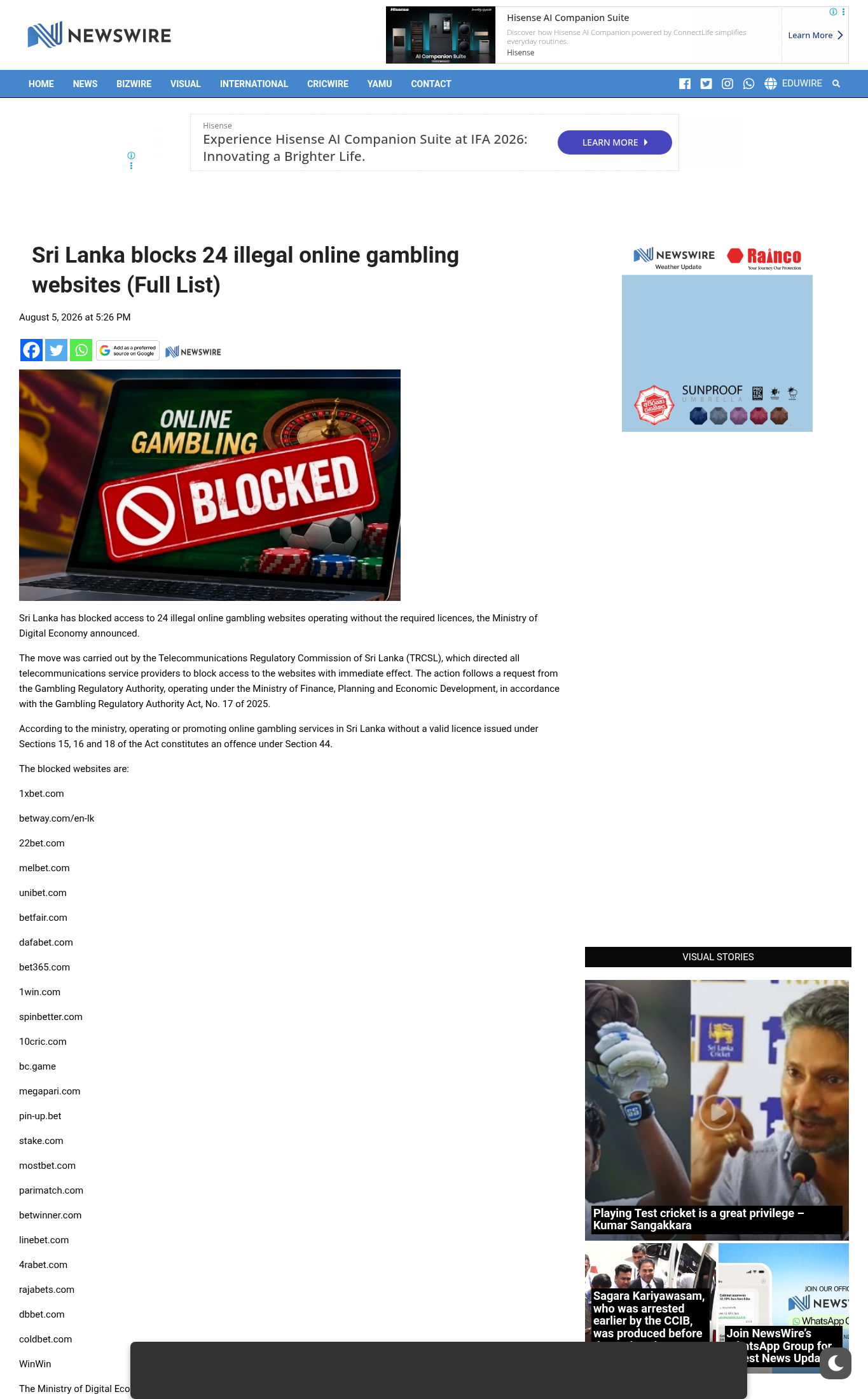
This is significant adverse evidence, but its limits matter. The supplied item is a report of the Ministry/TRCSL action rather than a licence-register entry naming a legal entity. It supports the conclusion that Sri Lankan access to the exact domain was targeted. It does not, by itself, prove every allegation a user might make about balances, games, withdrawals or customer support.
| Question | Finding | Confidence boundary |
|---|---|---|
| Was the exact domain named? | Yes, according to the dated local block report | Applies to bet365.com, not automatically to every lookalike |
| Is a Sri Lankan licence verified? | No | No accepted record in the packet matches a current local licence to the host and entity |
| Is a local operator verified? | No | The accountable Sri Lankan legal entity remains unknown |
| Were payments tested? | No | No conclusion about deposit or withdrawal performance is justified |
3. Local law, licensing and the operator gap
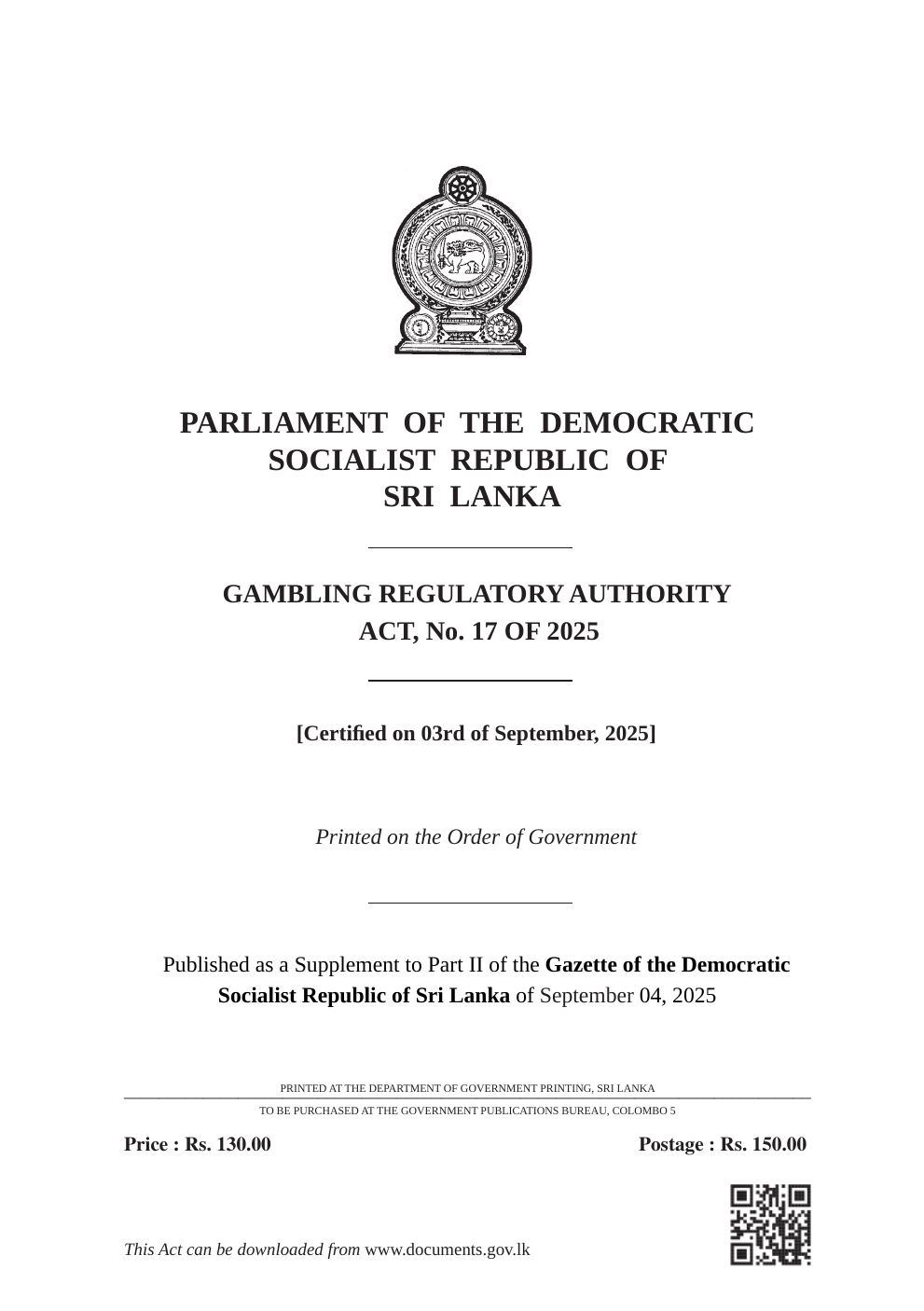
Act No. 17 of 2025 establishes the Gambling Regulatory Authority and a local licensing framework. The supplied parliamentary record explains the statutory structure but does not name this brand or confirm authorisation for the exact domain. The relevant Gambling Regulatory Authority Act record should therefore be read as framework evidence, not as a licence for a particular service.
A defensible licence match needs four connected elements: the precise hostname, the legal operator, a current licence identifier and a regulator record covering the relevant activity and market. None may be replaced by a footer badge, copied certificate, tax reference or overseas claim. In the accepted packet, the operator is not verified in the current Sri Lankan record and no current Sri Lankan licence is verified.
The Inland Revenue Department describes betting and gaming levy scope, including internet bookmakers, in its betting and gaming levy guidance. Tax scope and licensing are distinct. Being within a tax category does not demonstrate that one named domain holds regulatory permission, and paying a levy would not by itself cure a missing host-to-operator licence match.
4. Scam, legitimacy and legal status are different tests
“Scam”, “legitimate” and “legal” should not be treated as interchangeable labels. Fraud requires evidence about deceptive conduct. Legality depends on applicable law and authorisation. Operational legitimacy also depends on identifying the accountable entity, verifying terms and assessing whether users have realistic recourse. The records support a red local risk signal without establishing every possible fraud allegation.
| Test | Evidence available | Responsible conclusion |
|---|---|---|
| Exact-domain status | Named in a reported Sri Lankan block action | Serious adverse local signal |
| Local licence | No current matching licence supplied | Do not describe the service as licensed in Sri Lanka |
| Local legal entity | Not verified | Accountability and complaint routing remain uncertain |
| Fraud allegation | No competent finding supplied | Do not claim proven fraud |
| Payment reliability | No controlled test or verified transaction record | Unknown |
The practical outcome is caution, not speculation. A person in Sri Lanka should not deposit merely because the name is internationally recognisable. The local block evidence and missing local authorisation match outweigh unsupported marketing signals. For a broader comparison of locally relevant checks, use the casino evidence index.
5. Deposits, withdrawals and KYC exposure
No account was opened, no deposit was made and no withdrawal was attempted for this assessment. Accordingly, there is no verified evidence about accepted Sri Lankan payment methods, transaction fees, currency conversion, processing time, minimum withdrawals, rejected payouts or balance recovery. Any precise promise about those matters would be unsupported.
KYC can involve high-value identity material, including identity documents, address evidence, payment records or source-of-funds information. The Financial Intelligence Unit describes AML/CFT duties for casinos and a customer due-diligence threshold in its casino compliance guidance. That general framework does not verify this service’s local compliance. It does show why identity checks may exist in regulated activity and why documents should be sent only after the receiving entity and lawful basis are established.
Before any payment, record the exact hostname, displayed entity, currency, fee, withdrawal conditions and recipient name. Stop if a recipient changes unexpectedly, payment is requested through a personal account, or support demands further deposits to release existing funds. Those patterns are risk indicators, not proof about this specific operator. The payment-risk guide explains how to preserve transaction evidence.
Check first, then open the decision gateway
6. What to do after depositing or uploading documents
If money has already been sent, do not make another payment solely to “unlock” a withdrawal, pay an unexpected tax or satisfy an unsupported verification demand. Save account statements, receipts, transaction references, terms shown at the time, support messages and screenshots containing the complete address bar. Keep original files and note dates in Sri Lanka time.
- Ask the service for a written explanation, the legal operator name, the contractual basis for any restriction and a clear complaint reference.
- Contact the bank, card issuer or payment provider promptly. Describe the transaction accurately and ask what dispute, recall or account-security options remain available.
- Change reused passwords, enable multi-factor authentication where possible and monitor email and financial accounts.
- If identity documents were exposed, retain proof of submission and watch for impersonation or account-opening attempts.
- Escalate through the appropriate documented channel rather than paying a third-party “recovery agent” promising guaranteed results.
The complaint guide provides an evidence checklist. Urgent financial distress, threats or loss of control should be addressed through urgent support options. Neither route guarantees recovery, but early, organised action can preserve choices.
Check first, then open the decision gateway
7. Complaints and realistic routes to redress
The missing verified Sri Lankan operator creates a practical complaint problem: it is harder to identify which entity owes a response and which regulator can compel one. Begin with a written complaint to the entity shown in the account terms, while independently checking whether that entity genuinely controls the exact hostname. Request a final response and retain the complaint identifier.
A useful complaint states the account identifier, disputed amount, transaction dates, requested remedy and a short chronology. Attach only relevant evidence, redact unrelated financial information and never send passwords or one-time codes. If the issue concerns a payment, the payment provider may need a different evidence set from a gambling regulator or law-enforcement body.
Do not overstate the case. Describe a blocked domain as reported blocked; describe a failed withdrawal as your documented experience; and call fraud proven only if a competent authority has established it. Accurate wording makes the complaint easier to evaluate and reduces the risk of confusing allegation with verified fact.
8. Evidence chronology and what remains unknown
| Date or check | Record | Relevance |
|---|---|---|
| 2025 | Act No. 17 of 2025 | Establishes the Gambling Regulatory Authority and local licensing framework |
| 5 August 2026 | Local block report | Names bet365.com among 24 domains in the reported Ministry/TRCSL action |
| 1 September 2026 | Evidence packet checked | No current Sri Lankan licence or local operator match was verified |
| Not performed | Account and transaction test | Deposits, KYC handling and withdrawals remain untested |
Important unknowns include the current legal entity serving Sri Lankan users, any valid local licence identifier, licence expiry, locally accepted payment methods, withdrawal performance, complaint response quality and the present technical reachability of the domain. Reachability can change and is not equivalent to permission. A site loading today would not cancel the block evidence or create a licence.
The red signal rests on corroborated adverse evidence: an exact-domain block report combined with the absence of a verified current local licence and operator match in the accepted records. It is not based on anonymous complaints, a personal gambling experience or an invented transaction test.
9. Method, corrections and safer decision rules
The assessment separates legislation, government guidance, operator-derived imagery and the independent local report. The favicon is used only as a visual identifier. The statute establishes the framework. FIU and Inland Revenue records explain general compliance and levy context. The block report supplies the domain-specific adverse evidence. The full evidence method explains these source roles.
A correction should include a current competent-source record connecting the exact hostname to a named legal entity and Sri Lankan licence, or an official record changing the reported block status. Marketing text, an undated screenshot or an overseas licence alone would not resolve the local mismatch. Supporting material can be submitted through the correction contact.
Until stronger primary evidence changes the position, the safer rule is simple: do not bypass a block, do not trust a mirror because it resembles the familiar brand, do not send identity documents before verifying the recipient, and do not deposit on the strength of access alone. Gambling can also cause financial harm even where a service is authorised; limits and support options are available in the responsible gambling guide.
10. Frequently asked questions
Is Bet365 legal in Sri Lanka?
No current Sri Lankan licence for the exact domain and a matching local operator was verified in the accepted records. A dated local report also names bet365.com in a Ministry/TRCSL block action. The evidence therefore does not support describing the service as locally authorised.
Does the red signal mean proven fraud?
No. The red signal reflects corroborated adverse local evidence: the exact domain was reported blocked and no current Sri Lankan licence match was verified. The records do not establish every possible fraud allegation or prove that every activity associated with the international brand is fraudulent.
How can I identify a clone or mirror?
Read the complete hostname, reject spelling variations and extra words, and independently match the domain to a named legal entity and current licence. A copied logo, encrypted connection or working sign-in screen does not prove that a mirror is genuine or authorised.
Were deposits or withdrawals tested?
No. No account, deposit, withdrawal or customer-support test was performed. Payment methods, fees, processing times, KYC handling and withdrawal reliability are therefore unknown and should not be inferred from advertising or user comments.
What should I do if my withdrawal is blocked?
Preserve statements, transaction references, terms and support messages; request a written decision and complaint reference; and contact the payment provider promptly. Do not send another payment merely to unlock funds, and describe unproven wrongdoing as an allegation rather than an established fact.
What evidence could change the verdict?
A current record from a competent Sri Lankan authority matching the exact hostname, legal operator and valid local licence could change the licensing assessment. An official update rescinding or clarifying the reported block would also be relevant. An overseas licence, marketing claim or undated screenshot would not be sufficient by itself.