1win in Sri Lanka: legal status, KYC and block evidence

An identity-document mismatch is the first practical warning. A player may be asked to submit a National Identity Card, passport, address record or payment evidence, yet the current evidence packet does not identify a verified Sri Lankan licensee responsible for receiving those documents. If the account name, payment name and identity record do not match exactly, verification or withdrawal may become difficult. More importantly, even perfectly matching documents do not resolve the legal problem attached to the exact domain.
The available evidence supports a red risk signal for 1win.com in Sri Lanka. A dated local report attributes a block order covering 24 illegal online gambling websites to the Ministry and the Telecommunications Regulatory Commission of Sri Lanka and names the exact domain. No current Sri Lankan licence has been verified for it, and the operator behind the service has not been matched to a local regulatory record. This is not a finding that every transaction is fraudulent. It means the available adverse domain evidence is materially stronger than the unverified claims needed to establish lawful local operation.
Verdict: the exact domain carries documented local risk
| Question | Evidence finding | Practical meaning |
|---|---|---|
| Is the exact domain identified? | Yes: 1win.com is the domain assessed. | Lookalikes and alternate addresses are not covered by this identity match. |
| Is a Sri Lankan operator verified? | No operator is verified in the supplied local record. | Account holders lack a confirmed local entity match. |
| Is a current Sri Lankan licence verified? | No. | Do not treat access, registration or advertising as proof of authorisation. |
| Is there adverse domain evidence? | Yes. A local report names the exact domain in a Ministry/TRCSL block list. | The reported block is a strong reason not to deposit or provide identity documents. |
| Were payments or withdrawals tested? | No. | No claim about speed, success, fees or reliability can be made. |
The red signal is based on corroborated adverse reporting rather than a directly supplied regulator notice. The dated Sri Lankan report on the 24-domain block order attributes the action to the Ministry and TRCSL and includes the exact domain. That distinction matters: the report is specific and dated, but the underlying administrative order was not included in the packet. The conclusion therefore stays narrow—documented local blocking risk, no verified local licence and no verified local operator.
Legal host, operator and licence do not form a verified chain
A credible legality check requires three identifiers to align: the hostname used by the customer, the legal entity accepting the account, and the licence authorising that entity for the relevant market. Here, only the hostname is fixed. The favicon is useful for brand identification but cannot establish corporate ownership. No accepted record connects the exact domain to a named Sri Lankan licensee.
Act No. 17 of 2025 establishes the Gambling Regulatory Authority and a local licensing framework. The Act is evidence of the framework, not evidence that this service holds a licence. It does not name the brand in the supplied record. A lawful framework and a licensed operator are separate propositions; the first cannot be used to infer the second.
| Identity layer | What is established | What remains unverified |
|---|---|---|
| Domain | The assessment concerns 1win.com. | Whether any alternate address belongs to the same accountable entity. |
| Brand marker | A locally stored exact-domain favicon is available. | Corporate ownership, licence status and regulatory approval. |
| Operator | No local operator is established by the packet. | Legal name, registered address and responsibility for customer funds. |
| Licence | Sri Lanka has a statutory regulatory framework. | A current authorisation covering the entity and exact domain. |
A player checking legality should require a regulator record that names the legal entity, gives a current licence identifier and can be tied to the precise hostname. A badge, footer statement, brand-coloured seal or reachable registration form is not an equivalent substitute. The safer conclusion remains that local authorisation is unverified.
Reported block order and what it proves
The block evidence is the strongest brand-specific record in the packet. The report dated 5 August 2026 states that Sri Lanka ordered the blocking of 24 illegal online gambling websites and names the exact domain among them. Because the report attributes the action to public authorities, it is more significant than a complaint, social-media post or anonymous user allegation.
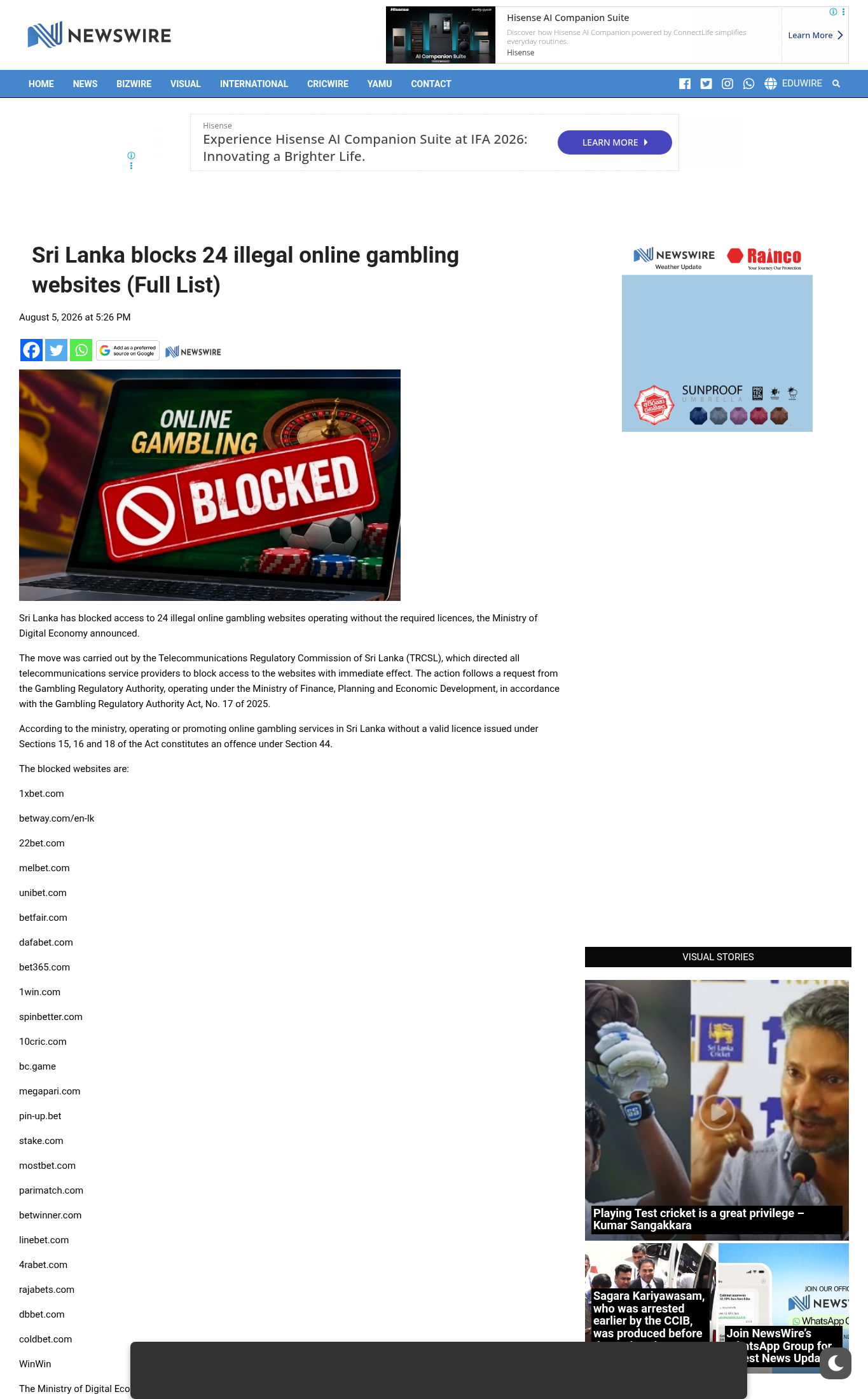
The report does not, by itself, prove that every account interaction is a scam, that every withdrawal fails or that a particular individual committed wrongdoing. Those claims would require separate evidence. It does support the narrower legal-risk conclusion that Sri Lankan authorities reportedly targeted this exact online address as part of an illegal-gambling block.
Technical accessibility is not a rebuttal. A domain may remain reachable through some networks, cached pages, mirrors or changed routing. Likewise, an account login that still works does not establish permission to offer gambling services locally. The meaningful test is a current, verifiable local authorisation tied to the responsible entity and hostname—not whether a screen loads.
KYC: do not send documents before accountability is clear
Know-your-customer checks can involve highly sensitive material. An identity document may reveal a photograph, full name, date of birth, signature, document number and address. A payment record can expose bank or wallet details. Before uploading anything, a customer should know which legal entity receives it, why it is required, how long it is retained, where a complaint can be lodged and whether the entity is authorised to serve Sri Lankan users.
The Financial Intelligence Unit describes casino AML/CFT duties and the applicable customer due-diligence threshold. Those obligations explain why regulated businesses may need identification. They do not validate an unidentified online operator, nor do they mean every request for a document is legitimate. A KYC request should be assessed together with the licence and entity chain.
| KYC check | Acceptable consistency | Reason to pause |
|---|---|---|
| Account holder | Name and date of birth match the identity record. | Someone else created or controls the account. |
| Payment owner | Deposit instrument belongs to the verified account holder. | Third-party card, bank account or wallet was used. |
| Recipient | A disclosed legal entity matches a current regulatory record. | Documents are requested without a verifiable accountable entity. |
| Purpose | The request explains what is needed and why. | Repeated or expanding demands have no clear explanation. |
| Complaint path | There is a traceable written escalation route. | Only temporary chat or disappearing messages are offered. |
If documents have already been submitted, keep the original files, upload confirmations, dates and the exact address used. Do not send additional material merely to overcome an unexplained delay. Redact unrelated transaction data when appropriate, but never alter a document in a way that misrepresents identity or ownership.
Payments and withdrawals remain untested
No account, deposit or withdrawal test was performed. The packet does not support naming accepted payment methods, processing times, minimum amounts, fees, exchange rates or withdrawal success rates. It also does not establish whether customer funds are segregated, which entity appears on a bank statement, or how a disputed transaction would be handled.
Sri Lanka’s Inland Revenue Department explains the scope of the betting and gaming levy, including internet bookmakers. Tax scope is not a licence check. The fact that a category is addressed by taxation rules does not prove that a particular foreign-facing domain is authorised, safe or accountable to a local customer.
For an existing balance, avoid making a further deposit simply because a message says it will unlock a withdrawal, pay tax, raise a limit or complete verification. The supplied evidence does not show that such a request has occurred here; it is a general payment-risk safeguard. Request a written explanation, the contractual basis, the transaction reference and the legal entity handling the funds. Preserve the response before taking further action.
Payment-name consistency is especially important. The account holder, identity document and funding source should ordinarily point to the same person. A mismatch can complicate verification, but a match does not overcome the reported block or establish legality. Review general transaction safeguards in the payment-risk guide.
Build a complaint packet before escalating
A useful complaint is chronological and specific. It should distinguish what was promised, what occurred, what evidence exists and what remedy is requested. Avoid conclusions such as “scam” when the records only establish a delay or disagreement. For this service, the legal-status concern can be stated separately: the exact domain appears in the dated block report, while no current Sri Lankan licence or local operator has been verified.
| Record | What to preserve | Why it matters |
|---|---|---|
| Account identity | Username or account ID, registration date and verified email or telephone number. | Links the complaint to the correct account without publishing credentials. |
| Transactions | Amount, currency, date, payment reference and statement descriptor. | Allows a bank or payment provider to identify the transfer. |
| Withdrawal | Request time, status, requested amount and any rejection reason. | Creates a precise timeline rather than a general allegation. |
| KYC | Document type, upload date, receipt and subsequent requests. | Shows what sensitive information was provided and when. |
| Communications | Full emails or chat exports with dates and case numbers. | Preserves wording and avoids relying on memory. |
| Remedy | A clear request for payment, explanation, account closure or data action. | Gives the recipient a defined issue to answer. |
Send the complaint through a traceable written channel and retain a copy outside the account. Never include passwords, one-time codes or full card security details. If the response is absent or inadequate, contact the payment provider promptly and describe only documented facts. The complaint guide provides a structured escalation path, while urgent financial or personal harm belongs in urgent help.
Check first, then open the decision gateway
Clone, mirror and impersonation checks
The assessment is confined to 1win.com. A similar name, copied colour scheme, favicon or promotional message does not prove that another hostname is controlled by the same entity. Conversely, claiming to be an “official mirror” does not make an address lawful or safe. Do not infer ownership from appearance.
Before signing in, compare the complete hostname character by character. Watch for added words, substituted letters, unusual subdomains and links that redirect through unrelated addresses. A saved bookmark can reduce typing errors, but it does not cure the adverse legal evidence attached to the exact domain. Never enter credentials after following an unsolicited message.
The locally stored logo asset is not a licence seal and should never be used as one. It supports visual identification only. A strong identity check requires the domain, disclosed company and regulator entry to agree. At present that three-part match is missing. The licence-check procedure explains how to compare these identifiers without relying on a badge.
Evidence chronology, limits and correction path
| Date | Record | Relevance |
|---|---|---|
| 2025 | Act No. 17 of 2025 | Creates the Gambling Regulatory Authority and local licensing framework; it does not name the service. |
| 5 August 2026 | Local report of Ministry/TRCSL action | Names the exact domain among 24 illegal online gambling websites reportedly ordered blocked. |
| 1 September 2026 | Evidence packet checked | No current Sri Lankan licence or local operator match was verified; no account or payment test was conducted. |
The methodology separates legislation and public-agency material from operator-provided identity context and corroborated reporting. The statutory framework, FIU material and tax information describe Sri Lankan rules but do not license the brand. The favicon identifies presentation, not legal status. The dated block report supplies the brand-specific adverse connection.
Important unknowns remain: the accountable legal entity, a locally valid licence number, handling of customer funds, available payment methods, KYC retention, complaint response quality and withdrawal performance. None should be inferred from marketing, accessibility or the existence of an account. Method details are available under evidence methodology.
A correction should include a dated primary record that identifies the legal entity, exact domain, licence number, status and issuing authority, or the original authority record showing that the reported block attribution or domain list was incorrect. Account screenshots, promotional claims and undated badges are insufficient. Submit documented corrections through the contact route.
Check first, then open the decision gateway
Safer decision for Sri Lankan users
The practical conclusion is to avoid depositing money or submitting further identity material while the exact domain is reportedly blocked and no local licence or accountable operator is verified. Existing users should preserve evidence, request written answers and consider payment-provider escalation where a documented transaction problem exists.
Gambling losses should never be chased with another deposit or borrowed money. If play is becoming difficult to control, use responsible-gambling support or the self-exclusion guide. These safeguards address harm; they do not resolve a licence or payment dispute.
Frequently asked questions
Is 1win legal in Sri Lanka?
No current Sri Lankan licence has been verified for the exact domain. A dated local report says the Ministry and TRCSL ordered 24 illegal online gambling domains blocked and names 1win.com. The available evidence therefore supports a red risk signal, not a finding of lawful local operation.
Is 1win a scam or a legitimate service?
The records do not prove that every interaction is fraudulent, so a universal scam claim would overstate the evidence. They do show a reported block affecting the exact domain, no verified Sri Lankan licence and no verified local operator. Those findings are sufficient to treat the service as high risk in Sri Lanka.
Does the logo prove that the website is official or licensed?
No. The stored favicon is used only to identify the brand associated with the exact domain. A logo can be copied and is not evidence of corporate ownership, regulatory approval, payment safety or a current Sri Lankan licence.
Should I upload my NIC or passport for KYC?
Do not send additional identity material until the receiving legal entity, purpose, retention terms and complaint route are clear and independently verifiable. Regulated businesses may have customer due-diligence duties, but those duties do not validate an unidentified or unlicensed service.
Are deposits and withdrawals reliable?
That is unknown. No deposit, withdrawal or account test was performed, and the evidence packet does not establish methods, fees, processing times or success rates. Do not make another payment merely to unlock a withdrawal without a documented and independently verifiable basis.
What should I include in a complaint?
Include the account identifier, transaction references, dates, amounts, withdrawal status, KYC timeline, complete communications and the precise remedy requested. Keep passwords, one-time codes and full card security details out of the complaint, and preserve copies outside the account.